
The commentary is based mostly on the LXX, with frequent reference to the MT.
1 And the Lord spoke to Moses, saying, 2 Speak to the children of Israel, and take first-fruits of all, who may be disposed in their heart to give…
When we give of our “first-fruits,” this must mean we give both our best and before we take care of our own necessities. One is to give freely for: “let each one give as he purposes in his heart, not grudgingly or of necessity; for God loves a cheerful giver.” (2 Cor 9:7)
…and ye shall take my first-fruits.
Our first-fruits are in fact God’s and belong to Him. Just as God gives crowns to those who then return them to Himself (Rev 4:10) or talents for us to invest and give back to him, He gives us grace so that we may co-operate with it and return it to Him by doing His will. So, our first-fruits are given to us by God’s grace and ought to be returned back to God—as this is literally the heavenly experience and mode of living.
3 And this is the offering which ye shall take of them; gold and silver and brass
From the first-fruits, the faithful offer to God gold, silver, and brass. These metals have the following typological meanings that will be born out in the text:
Gold=God’s grace
Silver=The actual goodness of human nature, made in the image of God (Gen 1:31)
Bronze=The human tropos (the way nature operates), once fallen, made good by purifying grace (see Ex 38:22 LXX)
Man gives to God all of the preceding. He returns to God His own grace, as discussed beforehand. This is related to how man likewise gives to God his own efforts (i.e. goodness), as humanity has its own will and energy that co-wills and co-operates with God. Men, being fallen since Adam, have a deficient tropos which does not act consistently with human nature. God’s grace corrects this tropos (which is why it is gold in color, but an alloy not of gold but other metals, showing that the tropos is entirely human though it is colored/affected by God) so that man can give back to God both his grace and live up to what his nature really is. Gold, silver, and bronze are all related in this way.
4 and blue, and purple, and double scarlet, and fine spun linen, and goats’ hair, 5 and rams’ skins dyed red, and blue skins, and incorruptible wood, [and oil for the light, incense for anointing oil, and for the composition of incense,] 6 and sardius stones, and stones for the carved work of the breast-plate, and the full-length robe.
The following materials provided have the following types, though due to my weakness as an interpreter, there is more here than I can grasp:
All the types pertain to humanity.
Blue linen/yarn=Man’s contribution to conceiving a child
Purple linen/yarn=Royal human lineage (through David)
Double scarlet linen/yarn=Blood, such as a mother’s children, that of the martyrs, etcetera
It should be noted that the Theotokos was tasked with sowing purple and scarlet at the Temple. (Protoevangelicum, Par 10) She does not provide blue yarn, because she conceived by the Holy Spirit.
The linen is intertwined with “goats’ hair” because the purple and scarlet yarn contains a sacrificial element, namely the incarnate Lord who acts as Israel’s scapegoat. (Lev 16) Even the blue thread has goats hair, as those of us who are baptized into Christ have put on Christ, and are Christ as He indwells us. (Gal 2:20, 3:27)
The rams’ (Gen 22:13 MT) skins dyed red and blue represents the death of Christ (red) and the martyrs (blue), the latter figuratively making up “what is lacking in the afflictions of Christ, for the sake of His body, which is the church.” (Col 1:24)
Incorruptible (acacia) wood is named afterwards, as it’s a type for human righteousness and blamelessness. It comes after the invoking of sacrificial deaths, as they are the epitome of human righteousness.
The oil is another type for the Holy Spirit, as it is used for lamps and God is Light. (1 John 1:5) Oil is used for anointings elsewhere, prefiguring chrismation.
Incense is a type for prayer, both done by the Holy Spirit on our behalf as He “makes intercession for us with groanings which cannot be uttered” (Rom 8:26) and by the saints (Rev 5:8). Both are represented by incensed infused oil and plain incense respectively.
The stones represent the “living stones” that “are being built up a spiritual house, a holy priesthood, to offer up spiritual sacrifices acceptable to God through Jesus Christ.” (1 Pet 2:5) This is why sardius (ruby) is named, as the blood of Christ is what gives these stones redemption. (Eph 1:7) The stones vary in preciousness as there are many mansions in heaven (John 14:2) according to the righteousness worked by each during their life. (2 Cor 5:10)
7 And thou shalt make me a sanctuary, and I will appear among you.
The entire sanctuary/tabernacle primarily represents the incarnation of God (“I will appear among you”).
8 And thou shalt make for me according to all things which I shew thee in the mountain; even the pattern of the tabernacle, and the pattern of all its furniture: so shalt thou make it.
The Scriptures state that the Jews used to “serve the copy and shadow of the heavenly things, as Moses was divinely instructed when he was about to make the tabernacle.” (Heb 8:5) The copy and shadow is of Christ Himself—He came “through [διὰ] the greater and more perfect tabernacle not made by hands,” His human body. (Heb 9:11)
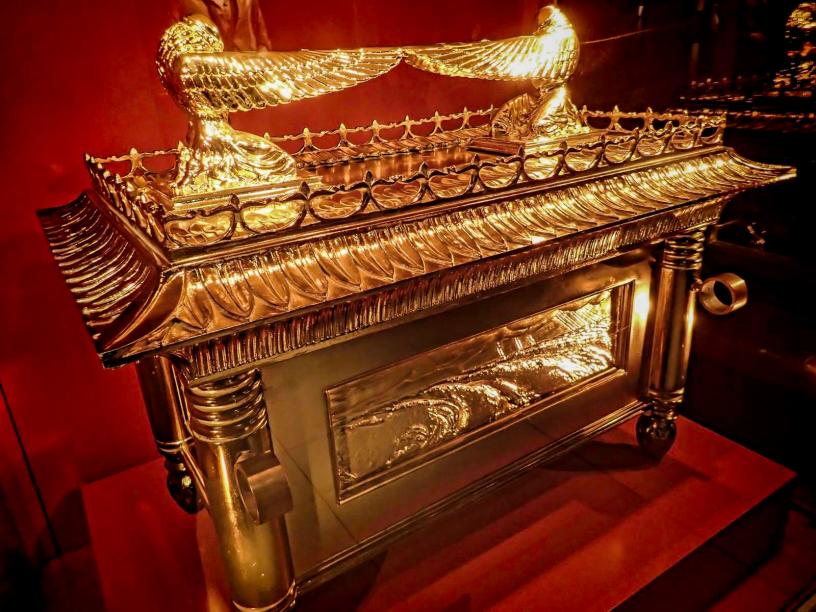
9 And thou shalt make the ark of testimony of incorruptible wood; the length of two cubits and a half, and the breadth of a cubit and a half, and the height of a cubit and a half. 10 And thou shalt gild it with pure gold, thou shalt gild it within and without; and thou shalt make for it golden wreaths twisted round about.
The “ark,” here, is Christ. He is made of “incorruptible wood.” Christ’s humanity is righteous and blameless, as He was conceived sinlessly from the Virgin, exempting Him from original sin. To quote Saint Hippolytus:
[T]he ark made of imperishable wood was the Saviour Himself. For by this was signified the imperishable and incorruptible tabernacle of (the Lord) Himself, which gendered no corruption of sin. For the sinner, indeed, makes this confession: My wounds stank, and were corrupt, because of my foolishness. But the Lord was without sin, made of imperishable wood, as regards His humanity; that is, of the virgin and the Holy Ghost inwardly, and outwardly of the word of God, like an ark overlaid with purest gold. (Commentary on “The Lord is My Shepherd” in Fragments)
The Theotokos is the ark as a secondary type. The type primarily is Christ. It is secondarily the Theotokos because she provided Christ His human nature, as the ark its imperishable wood.
This was accomplished through a purification at the annunciation in which the incarnation of Christ by the Spirit annihilated and utterly undone her original sin. This event was the most unmitigated experience of Theosis up to that point in history. It is only exceeded by the Theotokos after the assumption (which is why the Theotokos is continually liturgically commemorated—it is for her infinitely increasing spiritual benefit).
The “furniture” are the saints, angels, and “heavenly things themselves” which are purified by Christ’s blood. (Heb 9:23) They are continually “purified…with better sacrifices,” that is liturgical commemoration. (Heb 9:23)
The dimensions of the ark, being not a perfect square nor measured in round numbers as the heavens are (Rev 21:6), point to it being an imperfect shadow and copy. The ark, being a cuboid instead of a cube, points to the preceding.
Likewise, it is “gilded” because it is imperfect. The gold is “pure” because it represents pure God, His grace (energies), conveyed through no angelic intermediary. The gold is from both “within and without” the incorruptible wood, because though Christ has blameless humanity from the Theotokos (the acacia wood), He is not God by grace. He is incarnate God. Humanity is a partaker in God (2 Pet 1:4) only by grace, and so is overlayed with gold only on the outside. This is not so with Christ, hence the gold inside and out.
The “wreaths” are a type I do not quite know. I venture to guess that they convey beauty, as God is Beauty. (Wis 8:2, 13:3-5)
11 And thou shalt cast for it four golden rings, and shalt put them on the four sides; two rings on the one side, and two rings on the other side. 12 And thou shalt make staves [of] incorruptible wood, and shalt gild them with gold.
The “gold rings” are on the corners of the ark, its outmost extremities, representing God’s grace reaching out to man. Man reaches out to God to attain to this grace: “Draw near to God and He will draw near to you.” (James 4:8) The staves are of “incorruptible wood” because man reaches out to God in a state of “holiness, without which no one will see the Lord.” (Heb 12:14) The staves are covered with gold because man reaches out in holiness only by grace. This is because “Jesus” is “the author and finisher of our faith.” (Heb 12:2) The staves are not inwardly golden, not only because of obvious impracticality, but the continuation in types. Only God is golden inside and out.
13 And thou shalt put the staves into the rings on the sides of the ark, to bear the ark with them.
The ark is bore by the staves, as Christ is with us when we pursue Him with holiness by His grace. If we reach out to God apart from relying and seeking His grace, we are struck down like Uzzah. (2 Sam 6:3-7 MT) Such a temperament is not how one maintains the grace of the Spirit within his own temple, the body. (1 Cor 3:16-17) “God opposes the proud but gives grace to the humble.” (James 4:6) One can only approach God with holiness (Heb 12:14).
14 The staves shall remain fixed in the rings of the ark.
Humanity is to be continually remain fixed in the grace of God for eternity in heaven.
15 And thou shalt put into the ark the testimonies which I shall give thee.
The commandments are in the ark, because the moral obligations are in fact eternal laws of the Spirit. (Rom 8:2) They point to what the ceremonial Law cannot do, which governed the literal ark, pointing to the eternal ark who “in the likeness of sinful flesh” (the materiality of the ark) “condemned sin in the flesh, that the righteous requirement of the law might be fulfilled in us who do not walk according to the flesh but according to the Spirit.” (Rom 8:3-4) Hence, the ark being constructed in this way points to this always being the purpose of God.
16 And thou shalt make a propitiatory [mercy seat], a lid of pure gold; the length of two cubits and a half, and the breadth of a cubit and a half.
The mercy seat is pure gold, because it points to the divinity of Christ. Likewise, it points to His blameless sacrifice, God dying in the flesh. The dimensions likewise point to the imperfection of this copy.
17 And thou shalt make two cherubs graven in gold, and thou shalt put them on both sides of the propitiatory [mercy seat]. 18 They shall be made, one cherub on this side, and another cherub on the other side of the propitiatory; and thou shalt make the two cherubs on the two sides. 19 The cherubs shall stretch forth their wings above, overshadowing the propitiatory with their wings; and their faces shall be toward each other, the faces of the cherubs shall be toward the propitiatory.
The cherubs are golden, because they are spiritual and are intermediaries of God’s grace as Saint Dionysius details. They are on both sides of the mercy seat because angels perpetually serve this function as a media of grace to humanity. Their wings overshadow the mercy seat because much of humanity’s interaction with grace is through the angelic, who not only delivered the Scriptures to mankind (Acts 7:53, Gal 3:19), but also constantly intercede for us such in the function of guardian angels. (Matt 18:10) Their faces are towards one another, as this implies their gazing at the invisible divine nature, which is only apprehended in God’s energies and not His essence. They are likewise towards the mercy seat, because they are always directed towards Christ in their worship, Who even in heaven appears as “a Lamb as though it had been slain.” (Rev 5:6)
20 And thou shalt set the propitiatory [mercy seat] on the ark above, and thou shalt put into the ark the testimonies which I shall give thee.
The mercy seat is above the ark, because Christ’s greatest glory is His crucifixion and resurrection. The commandments are below, typologically pointing to the inferiority of the Law to its fulfillment. Granted, the Law in the ark is eternal which is why Christ states, “one jot or one tittle will by no means pass from the law till all is fulfilled.” (Matt 5:18) Even still, Christ’s work is always more important than eternal moral requirements, which secondarily follow His work.
21 And I will make myself known to thee from thence, and I will speak to thee above the propitiatory [mercy seat] between the two cherubs, which are upon the ark of testimony, even in all things which I shall charge thee concerning the children of Israel.
“I will make myself known to thee from thence” is in fact typological, as it points to how there is newfound clarity after the incarnation: “The only begotten Son, who is in the bosom of the Father, He has declared Him.” (John 1:18) The speaking “above” the mercy seat pertains to God the Father speaking to the Church over and above what is declared during the liturgy (in prayers, preaching, etcetera). God is always revealing Himself to mankind and directing His people. It also holds this significance: it shows that though the ark is Christ, that seated above Christ is the Father—the latter being the eternal cause to the former.
22 And thou shalt make a golden table of pure gold, in length two cubits, and in breadth a cubit, and in height a cubit and a half. 23 And thou shalt make for it golden wreaths twisted round about, and thou shalt make for it a crown of an hand-breadth round about. 24 And thou shalt make a twisted wreath for the crown round about.
The pure gold table (for the showbread and wine) represents where priests offer the Eucharist—it being pure gold pointing to the sacrifice on the table being purely God, not merely bread. The MT states the table is made of acacia wood overlaid with gold, perhaps speaking to the purity of the hands of the bishop presiding over the liturgy, a work done by grace. The bishop both cleans his hands and is purified by confession and the overshadowing of the Holy Spirit (as indicated by the Liturgy of Saint John Chrysostom) before the consecration. I prefer the LXX and believe the emphasis herein gleaned concerning the acacia wood pertains to the staves mentioned in the next section.
The wreaths again point to the Beauty that is God. The crown is the table’s frame and they too have wreaths, showing the frame are likewise God. This points to God being the principle of sufficient reason, upholding all things, having aseity.
25 And thou shalt make four golden rings; and thou shalt put the four rings upon the four parts of its feet under the crown. 26 And the rings shall be for bearings for the staves, that they may bear the table with them. 27 And thou shalt make the staves of incorruptible wood, and thou shalt gild them with pure gold; and the table shall be borne with them.
Similar to the ark, the table (which is in fact an altar) is a point in which God’s grace reaches out to man (symbolized by the gold rings). The tables’ leg point to God’s aseity. Humanity, not having aseity, can only approach God with purity, symbolized by the staves made of acacia wood. With purity we approach the altar (“bear the table with them”).
28 And thou shalt make its dishes and its censers, and its bowls, and its cups, with which thou shalt offer drink-offerings: of pure gold shalt thou make them. 29 And thou shalt set upon the table shewbread before me continually.
The pure gold of the utensils points to the sacrifice being God Himself—they are imparted the grace of God and convey His grace, which is why these holy objects are venerated. The continual presence of drink offerings and showbread, this table being placed closest to the ark, points to the perpetual nature of the Eucharistic sacrifice. As Saint Ignatius of Antioch taught: “the Eucharist is the flesh of our savior Jesus Christ, which suffered for our sins and which the Father by his goodness raised up.” (Smyrnaeans 6.2)
30 And thou shalt make a candlestick of pure gold; thou shalt make the candlestick of graven work: its stem and its branches, and its bowls and its knops and its lilies shall be of one piece. 31 And six branches proceeding sideways, three branches of the candlestick from one side of it, and three branches of the candlestick from the other side. 32 And three bowls fashioned like almonds, on each branch a knop and a lily; so to the six branches proceeding from the candlestick, 33 and in the candlestick four bowls fashioned like almonds, in each branch knops and the flowers of the same. 34 A knop under two branches out of it, and a knop under four branches out of it; so to the six branches proceeding from the candlestick; 35 and in the candlestick four bowls fashioned like almonds. 36 Let the knops and the branches be of one piece, altogether graven of one piece of pure gold. 37 And thou shalt make its seven lamps: and thou shalt set on [it] the lamps, and they shall shine from one front. 38 And thou shalt make its funnel and its snuff-dishes of pure gold. 39 All these articles [shall be] a talent of pure gold.
In short, the candelabra has seven total flames, representing the “[s]even lamps of fire were burning before the throne, which are the seven Spirits of God.” (Rev 4:5) In other words, the candelabra made of “pure gold” must represent divinity, consistent with solid gold construction—it represents the Holy Spirit. It is uncoincidentally located before the ark as the Holy Spirit is before the throne of God the Father. The metaphorical distance represents the Holy Spirit’s sole cause, His eternal procession, from the Father. However, the primary typology of the ark is it representing the incarnate Christ. Christ makes the Father known. (Matt 11:27) So, the Spirit is made known to man through procession by the Son. (John 15:26, 16:7)
The preceding exegesis sounds like eisegesis. There is a real danger of this when exegeting typology. However, it is not. Presuming the consistency of the Scriptures, consider the following:
For those who would distort this type, the Book of Revelation provides the key. The throne in Revelation is the Father’s and the Son, (Rev 3:21) the latter sitting at the former’s right hand. (Mark 16:19) But, the Spirit is with the Son when he approaches the Father’s throne. (Rev 5:1, 6) This points to the eternity of each hypostasis of the Holy Trinity. The Spirit is both with the Son on the throne in Rev 3:21, but also apart from the throne and the Son, as He proceeds from the Father and Son to mankind. Proof of this can be seen in Rev 4:5, where the Spirit is before the throne as discussed previously. Additionally, one must follow Saint John in recounting the heavenly vision up to Rev 5:6-7. The Son, in this context, was not seated on the throne itself. Just as the Spirit being before the throne connotes a distance, the Son’s distance from the throne likewise connotes a distance—both pointing to the Father’s causal relationship with the Son and Spirit. The Spirit being with the Son in this context is a reference to the temporal procession. So, when the Son sits on the throne (as implied by Rev 3:21 and the solid gold mercy seat), the Spirit is in fact with the Son (Rev 5:6) because the Spirit proceeds from the Father (above the throne) and rests in the Son. (Damascene, Exposition of the Orthodox Faith, Book 1, Chap 8)
The candelabra has six ornamentations which likewise function practically: stems, branches, bowls, knops, lilies, and almonds. These represent Beauty, which being visible to mankind, represent the diversity of divine energies which are conveyed to and uphold creation. (1 Cor 12:4) At the center of the candelabra is the staff which lacks ornamentation, but has a flame. Being one, this represents the simple divine essence of the Holy Spirit. Having a flame connotes how energies, visible to man, reveal the same divinity which essentially exists.
The importance of the funnel and snuff dishes are hard for me to discern. Their pure gold, and the fact they are all part of the same one talent of gold, conveys they are effectually part of the lampstand (i.e. Holy Spirit). Perhaps the fact these pure gold implements are in such articles used for the lampstand’s maintenance conveys the essential and energetic presence of the Spirit in Christians. He really indwells believers in a direct way.
40 See, thou shalt make them according to the pattern shewed thee in the mount.
This reminder underscores the importance of the preceding details, when understood typologically, is obvious.
 Orthodox Christian Theology