
The commentary is based mostly on the LXX, with frequent reference to the MT.
1 And thou shalt make an altar of incorruptible wood, of five cubits in the length, and five cubits in the breadth; the altar shall be square, and the height of it shall be of three cubits. 2 And thou shalt make the horns on the four corners; the horns shall be of the same piece, and thou shalt overlay them with brass. 3 And thou shalt make a rim for the altar; and its covering and its cups, and its flesh-hooks, and its fire-pan, and all its vessels shalt thou make of brass. 4 And thou shalt make for it a brazen grate with net-work; and thou shalt make for the grate four brazen rings under the four sides. 5 And thou shalt put them below under the grate of the altar, and the grate shall extend to the middle of the altar. 6 And thou shalt make for the altar staves of incorruptible wood, and thou shalt overlay them with brass. 7 And thou shalt put the staves into the rings; and let the staves be on the sides of the altar to carry it. 8 Thou shalt make it hollow with boards: according to what was shewed thee in the mount, so thou shalt make it.
The altar spoken of here is the one used for animal sacrifices. Interestingly, it’s typological meaning is not Eucharistic. Rather, it represents the “living sacrifice” of Christians living in a holy manner. (Rom 12:1) This is why everything is overlayed or made of bronze. The sacrifice here cannot be the Eucharist, but the holy living of redeemed people. (1 Cor 6:9-11) Grace has purified once sinful people into those that can offer pleasing spiritual sacrifices. The acacia wood of the altar indicates that this purification has imparted true righteousness to Christians.
The imperfect dimensions indicate the imperfection of the type. The grate underneath the rest of the altar indicates the different kinds of spiritual sacrifices and how one supports another. The brazen rings and poles represent the help Christians offer one another in building up the body of Christ.
The hollowness, though serving a practical function, typologically may point to the tentative nature of the Christian life. (1 Cor 10:12) The emphasis on following God’s design points to the importance of the types.
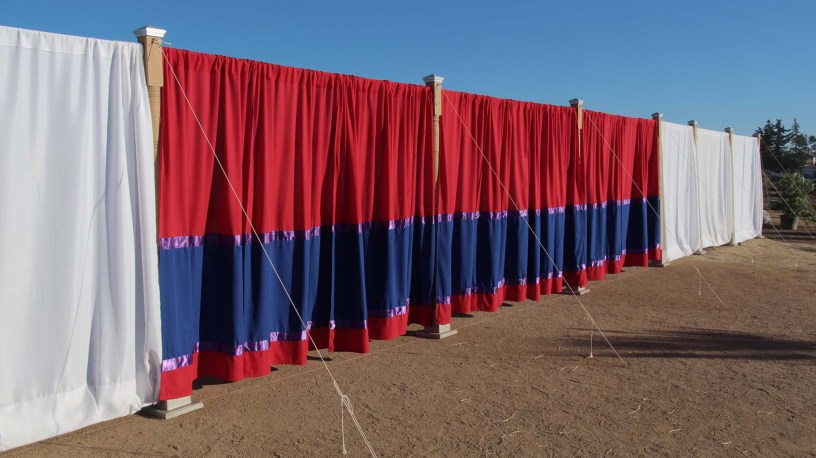
9 And thou shalt make a court for the tabernacle, curtains of the court of fine linen spun on the south side, the length of a hundred cubits for one side. 10 And their pillars twenty, and twenty brazen sockets for them, and their rings and their clasps of silver. 11 Thus [shall there be] to the side toward the north curtains of a hundred cubits in length; and their pillars twenty, and their sockets twenty of brass, and the rings and the clasps of the pillars, and their sockets overlaid with silver. 12 And in the breadth of the tabernacle toward the west curtains of fifty cubits, their pillars ten and their sockets ten. 13 And in the breadth of the tabernacle toward the south, curtains of fifty cubits; their pillars ten, and their sockets ten. 14 And the height of the curtains [shall be] of fifty cubits for the one side [of the gate]; their pillars three, and their sockets three. 15 And [for] the second side the height of the curtains [shall be] of fifteen cubits; their pillars three, and their sockets three. 16 And a veil for the door of the court, the height [of it] of twenty cubits of blue linen, and of purple, and spun scarlet, and of fine linen spun with the art of the embroiderer; their pillars four, and their sockets four.
The “court” surrounds the actual holy and holy of holies. It appears this represents catechumens. Bronze sockets indicate that God is purifying them by grace and silver indicates the goodness of their humanity, just as that of Christians. The pillars are not made of acacia wood, for those outside the Church do not have blamelessness which is imparted to those who are in Christ’s Body. The dimensions follow that of the actual holy and holy of holies, carrying the same sort of significance.
The height of the pillars and curtain (made of red, purple, and blue as catechumens are likewise men) is greatly exaggerated in the LXX—50 (πεντήκοντα) and 15 (πεντεκαίδεκα) cubits (approximately 25 and 8 meters respectively). 4Q22 PaleoExodus in the Dead Sea Scrolls puts the height at 5 cubits. Surely, this is more accurate. In any event, the number 5 indicates completion, not of the catechumens, but of God’s design in bringing them into the Church.
As for the origin of this very specific alternate number, with differing heights, this is difficult to guess. If this is the authentic rendering, does this indicate there are two curtains of varying heights? And why would this be? Does it point to adults and children? Were the heights meant to convey how even the catechumens are greatly separated from the world? How would ancients erect curtains the height of 7 story buildings and have them not blow over in the wind? While the impracticality may point to the impossible things God does, it is hard to imagine that any such thing was actually built.
Historically, the “catechumens” have always been the Gentiles being brought into the Church. For catechumens, purple is not royal lineage through David, but royalty in the world as: “The Gentiles shall come to your light, And kings to the brightness of your rising.” (Is 60:3 MT)
17 All the pillars of the court round about overlaid with silver, and their chapiters silver and their brass sockets. 18 And the length of the court [shall be] a hundred [cubits] on each side, and the breadth fifty on each side, and the height five cubits of fine linen spun, and their sockets of brass.
The significance of the pillars being overlaid with silver is that the goodness of human nature, apart from grace, really does not add more than a superficial goodness to base wood. Saint Paul calls this base wood “the flesh” and a “body of death.” (Rom 7:24-25) With a disordered tropos not purified by grace, human goodness only gets one so far. The brass sockets and silver hooks however give a glimpse of promise, that purifying grace and human goodness can exceed this state. The LXX here retains the height for the pillar and curtain being five cubits, which further indicates that 50 and 15 the passage before are a corruption entered into the text.
19 And all the furniture and all the instruments and the pins of the court [shall be] of brass.
All the instrumentation for religious services are bronze as even though catechumens do not commune, the icons, incense, and prayers all purify them and offer them sanctification onto salvation upon their entrance into Christian communion.
20 And do thou charge the children of Israel, and let them take for thee refined pure olive-oil beaten to burn for light, that a lamp may burn continually 21 in the tabernacle of the testimony, without the veil that is before the [ark of the] covenant, shall Aaron and his sons burn it from evening until morning, before the Lord: it is a perpetual ordinance throughout your generations of the children of Israel.
The pureness of the olive oil and the perpetuity of its burning in the candelabra speak of the perpetual work of the Holy Spirit in the world, and especially in the Church.
 Orthodox Christian Theology