
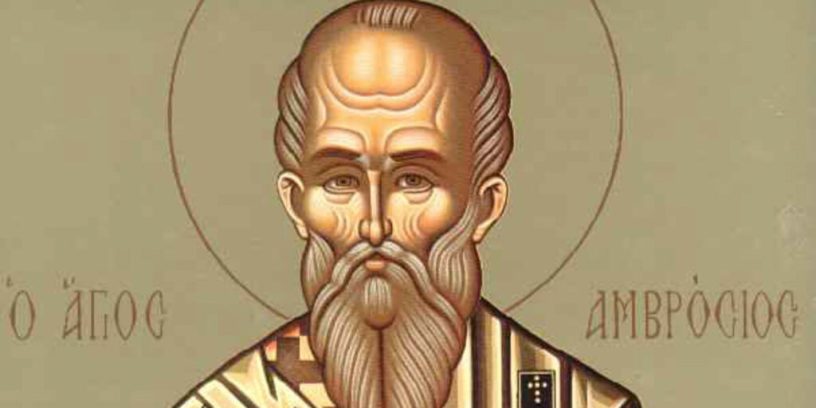
Trying to devise a history of a doctrine that is subject to significant controversy is difficult. The chief challenge is not to read a present-day controversy into the past. When it comes to the Orthodox Pneumatology (i.e. “single procession”) vis a vis the Roman Catholic doctrine of the Filioque as dogmatized in the post-schism Councils of Lyons and Florence (i.e. “double procession”),* the idea that either doctrine would be in the forefront of early Church Trinitarian thinking would require reading the controversy into early sources.
*“Single (eternal) procession” means the Spirit’s hypostatic, eternal origin is from the Father alone while “double procession” means His origin is from both the Father and the Son.
However old the doctrine of the Holy Trinity is, as it is certainly solidified by the second century and arguably earlier, the controversies surrounding Semi-Arianized Christology and Pneumatology did not begin until the fourth century. The conflict surrounding Semi-Arianism mostly pertained to Christology–Pneumatology was a secondary manner. And so, historically delineating what the historical Pneumatology of the Latin West was during this era requires recognizing that the main emphasis was always Christological.
In this article, we will make the case that in the Latin West single procession was what was expounded whenever the Spirit’s hypostatic origin was explicitly addressed. Contrarily, others have addressed this question with a western theological bias. They make the critical error of using patristic texts not explicitly addressing eternal origin, but instead addressing temporal procession or consubstantiality between the hypostases. Inferring hypostatic origin from such texts is a tricky business due to the subjective nature of such competing Orthodox and Western interpretations of said texts canceling each other out. And so, identifying patristic texts that are purposely and explicitly on the subject of the Spirit’s eternal origin is a more useful methodology when studying the question. It is important not to press beyond the stated patristic meaning and when doing so, being transparent and measured with one’s inferences.
The amount of explicit statements are fairly limited due to ancient and medieval theologians usually not addressing Pneumatology for its own sake, incidental as it was to combating some Semi-Arian idea that Christ was not of the same essence/substance as the Father. This makes it possible to offer a fairly definitive, article-length treatment of the topic. With the preceding in mind, it is now possible to review the history of the doctrine of “single procession” in the pre-schism Latin West.
Ambrose and Augustine. While Latin theologians have made comments on the Trinity before Ambrose, they were rudimentary or in Tertullian’s case, outright heretical and subordinationist. Clarified Triadology awaited the conflict with Semi-Arianism. Saint Ambrose, literate in both Greek and Latin, was preceded only by Saint Hilary of Poitiers in composing elaborate Latin defenses of Nicene Orthodoxy. Hilary’s Pneumatology is subject to debate and his potential comment in On the Trinity 2:29 on the question too vague to firmly assign him to the double processionist camp. In his drawn out, more transparent commentary on the subject, he only explicitly makes reference to the temporal procession of the Holy Spirit from the Father through the Son, especially in Book 8 of the same book.
As discussed previously, most pre-schism theologians East and West when commenting on this issue only explicitly discuss temporal procession. Therefore, an explicit discussion particularly on Pneumatological origin is rare, but not elusive. Ambrose in a passing comment makes a comment that on the surface espouses single procession:
For who will be the Father according to impious heretics, if from Him the nature of the Son is separated? And again, who will be the Son, if His origin is not referred back to the Father, so that He who begot is the Father, and He who is begotten from Him is the Son? Therefore, the Father, who is the origin of deity and goodness, is rightly understood and felt in both the Son and the Holy Spirit: in Him, that is, in the Son, as Word, by virtue and wisdom; but in this one, as Spirit proceeding from Him. Thus it is right and Catholic to confess one God according to the truth of substance, and to perceive the Father, Son, and Holy Spirit in their respective subsistence. (Ambrose, On the Trinity, Chap 2; PL 17:541)
Ambrose makes a simple point. The Father and the Son must share the same nature/substance/essence, and the Son (to properly be a son) must originate from the Father. Ambrose then clarifies the Father is origin of all deity and in this context clarifies that this applies to the Spirit’s procession.
Centuries into the future during the scholastic age, western theologians would logically defend the Father being the eternal origin of the Son and Spirit, but still deduce that the Spirit’s procession is contingent upon the Son as a co-cause, even if the Son is secondary as He had to be caused first, as it were (i.e. the primary/secondary cause apologetic). While this convoluted work-around is logically possible, it would be irresponsible to presume this is what Ambrose had on his mind as he says nothing of the sort. All that can be known for certain was what was said–and that is, the Father is the origin of the Son and Spirit, the Son by being begotten (generation) and the Spirit by procession.
If Ambrose is the forerunner of developed Latin theology on Pneumatology, his pupil, Augustine, is its founding father. It has been argued by myself that his psychological trinities in fact teach single procession. Here, for the sake of space, we will only discuss his most concise statements that explicitly discuss the Holy Spirit’s origin.
In several places he explicitly identifies the Father as the Spirit’s “originator”/”author”/”principle”/”origin”/”beginning.”
The Son comes from the Father; the Holy Spirit comes from the Father. The former is born; the latter proceeds. Hence, the former is the Son of the Father from whom He is born, but the latter is the Spirit of both because He proceeds from both. When the Son spoke of the Spirit, He said, “He proceeds from the Father,” [John 15:26] because the Father is the author [lit. ‘auctor’ or “originator”] of His procession. The Father begot a Son and, by begetting Him, gave it to Him that the Holy Spirit proceeds from Him as well. For if the Spirit did not also proceed from Him, the Son would not have said to the disciples: ‘Receive the Holy Spirit’; and by breathing on them, He gave it, showing openly, by breathing, that which He was giving secretly. (Augustine, Against Maximinus, 1:14:1; PL 42:770)
That then which the Lord says —Whom I will send unto you from the Father, — shows the Spirit to be both of the Father and of the Son; because, also, when He had said, Whom the Father will send, He added also, in my name. Yet He did not say, Whom the Father will send from me, as He said, Whom I will send unto you from the Father,— showing, namely, that the Father is the beginning (principium) of the whole divinity, or if it is better so expressed, deity. He, therefore, who proceeds from the Father and from the Son, is referred back to Him from whom the Son was born (natus). And that which the evangelist says, For the Holy Ghost was not yet given, because that Jesus was not yet glorified; how is this to be understood, unless because the special giving or sending of the Holy Spirit after the glorification of Christ was to be such as it had never been before? (Augustine, On the Trinity, 4:29)
Nevertheless, let them not proclaim the Holy Spirit as though He were begotten like a Son from the Father—for Christ alone is the only Son; nor let them speak of the Son as though He were a grandson of the highest Father. Yet they should not say that what He is, He owes to no one, but rather to the Father, from whom all things come, lest we establish two principles without a principle—something that is utterly false and absurd, and characteristic not of the Catholic faith but of the error of certain heretics. (Augustine, Of Faith and the Creed, Par 19 in PL 40:191)
As discussed previously, scholastic theologians after the schism were able to logically reconcile the idea that the Father is the “originator” of the Trinitarian Godhead. An honest observer would infer that Augustine does not apply this logic. He simply states the Father is the originator of procession within the context of the Father being the originator/principle of both generation and procession. However, according to Augustine this ties into a procession from the Son–and therein lies the debate. In both statements, the explicit context for this common procession between the Father and Son is temporal–but what if more is implied? Using another scholastic method, Occam’s Razor, one would first work with what’s explicitly there before inferring double procession.
Another statement from Augustine, justifies the simpler, single processionist reading that Occam’s Razor provided us:
Therefore, if these things are said in such a way that the inseparable operation of the Trinity is understood; so that when the operation of the Father is mentioned, it is understood that He does not work without the Son and the Holy Spirit; and when the operation of the Son is mentioned, it is not understood to be without the Father and the Holy Spirit; and when the operation of the Holy Spirit is mentioned, it is not understood to be without the Father and the Son: it is sufficiently known to those who believe rightly, or even to those who understand as much as they can, that it was said about the Father, ‘He Himself does the works,’ because from Him [the Father] is also the origin [origo] of the works, from [ab] Whom is the existence of the cooperating persons; because the Son was born from Him, and the Holy Spirit principally proceeds from Him, from whom the Son was born, and with whom the same Spirit is common to them: and what the Lord says, ‘If I had not done the works among them that no one else did, they would not have sinned,’ does not refer to the Father or the Spirit as not cooperating with Him in those works; but to the people, from whom many miracles are read as having been done, and yet none that the Son did: and what the Apostle says about the Holy Spirit, ‘But [in] all these works one and the same Spirit works,’ is not said because the Father and the Son do not cooperate with Him; but because in these works there is not many but one Spirit, and in His various operations, He is not different from Himself. (Augustine, Sermons on Scriptures, 1:16, PL 38:459)
Here, Augustine makes the argument that the Trinitarian Godhead has a singular energy/operation concordant with its singular substane/essence. He identifies an origin for this energy: the Father. He then equates this with the origin of the Son and Spirit: the Father. And so, “the Holy Spirit primarily proceeds from Him, from whom the Son was born, and with whom the same Spirit is common to them.”
This is similar to Book 15 of On the Trinity, where Augustine writes that “the Son is born of the Father; and the Holy Spirit proceeds from the Father principally, the Father giving the procession without any interval of time, yet in common from both [Father and Son].” (15:47) In the above “sermon,” however, Augustine makes clear what the common procession is–miracles done through the singular divine energy/operation.
In other words, the common procession is a temporal procession. Reading this definition back into all texts where Augustine uses the moniker “common” to define the procession between the Father and the Son, it becomes impossible to defend that Augustine was expounding double procession.
Augustine’s Pneumatology Spreads. As we can see, Augustine clarified Ambrose’s thought and explicitly taught a single-processionist Pneumatology. Augustine’s explicit Pneumatological arguments spread in the West immediately afterwards. During the mid-fifth century, Nicetas Aquileiensis perhaps found inspiration from Augustine as evidenced by a brief Pneumatological comment relevant to the Spirit’s origin:
But let no one think that this belief tends to dishonor God the Father, since rather it should be expected to bring glory, if the Word of Him who is Himself the Father, or the Spirit of Him (who is Himself the Originator [auctor]), is said to have created all things: for He Himself creates all things, since His Word and Spirit create. (Nicetas Aquileiensis [Roman Catholic Saint], The Power of the Holy Spirit, PL 52:858)
The argument is similar to Augustine in that because the Father is “the Originator,” the actions of the other Hypostases of the Holy Trinity are in fact His. One can infer from this that to make the Son origin of the Spirit, but the Spirit the origin of no one, dishonors the Spirit. Whether Nicetas would agree with this or not we will leave aside. Nevertheless, it suffices that his only explicit teaching is that the Father is the origin of the Spirit.
It was this explicitly single-processionist Pneumatology that would be adopted in Rome and in time gain some sort of official sanction. This would be thanks to Eugyppius. Coined “Augustine’s first editor,” this now mostly forgotten personality would prove to be of macro historical importance in that he popularized Augustine in Rome.
Following his master in his own writings, Eugyppius in summarizing Augustine’s thought repeats Sermons from Scriptures almost verbatim excluding anyone other than the Father from being the Spirit’s eternal cause:
These things are said in such a way that the inseparable operation of the Trinity is understood. Thus, when the operation of the Father is mentioned, it is not understood to be without the Son and the Holy Spirit; and when the operation of the Son is mentioned, it is not without the Father and the Holy Spirit; and when the operation of the Holy Spirit is mentioned, it is not without the Father and the Son. This is well known to those who believe correctly or even to those who can understand it, and it is said that this is true of the Father, because He does the works, since He is the origin [origo] of the works, from [ab] whom the existence of the cooperating persons comes [from], because the Son is born from Him, and the Holy Spirit principally proceeds from Him, from whom the Son is born, and with whom the same Christ is common. Hence, the Lord Jesus expels demons in the Holy Spirit. For He could not fulfill this alone, and He did not take this assistance as if He were insufficient for this work: but the spirit, being undivided in itself, was suitably expelled by that very Spirit which the Father and the Son have undivided in themselves. (Eugyppius, Thesaurus, PL 62:749)
The influence of Augustine through Eugyppius’ writings appeared to affect a contemporary, Paschasius Diaconus (another Roman Catholic saint). A deacon for (“anti”) Pope Laurentius, he was part of the Papal faction actually resident in Rome (unlike Symmachus). On the explicit question of Pneumatological origin, he wrote:
While the Father is the face*, the Son is called, and is recognized as coeternal, with the Father. Accept the Trinity from the sacred volumes. ‘In the beginning God created the heavens and the earth, and the Spirit of God moved over the waters’ (Gen. 1). The Father, the Originator, the coeternal principle, the Holy Spirit poured [superfusus, lit. “pouring out”] out upon the waters. Therefore, the Spirit was carried over the waters of the Despot [i.e. devil]; even then, I believe, foreshadowing the gifts of baptism. In the making of man also, it demonstrates that it is not the work of one person but of three Persons, the triple repetition of deity. (Paschasius Diaconus, PL 62:13)
*”That name, that is, face, pertains to the substance of unity and to the eternity of majesty.”
Similar to Augustine, the singular origin of the Father is what identifies all the works of the Holy Trinity as deriving from their singular essence. In making this observation, he explicitly identifies the Father as the Originator and conflates this with the Spirit’s “pouring” (superfusus)–seemingly a euphemism for procession. This inference is justified by a similar comment he makes elsewhere, where he invokes the inverse of superfusus, infusus, in order to explain how the Father is the origin of the Spirit’s procession:
And again: ‘The Spirit searches even the depths of God’ (1 Corinthians 2). Likewise, ‘the Spirit who proceeds from the Father’ (John 15). Unless this Spirit were from the Father, and naturally indwelling in [infusus, lit. “pouring into”] the eternal Father, He could not proceed from the Father. But you ask whether the Spirit always proceeds from the Father: always with Him, always from Him, just as heat from fire, so it is brought forth without interruption, knowing how to emanate, not knowing how to be separated. (Paschasius Diaconus, PL 62:20)
According to Catholic.com, “[Saint Pope] Gregory [the Great] remarks that Paschasius had left books on the Holy Spirit that were correct in all particulars and perfectly intelligible.” Gregory’s actual remark (“Paschasius’…most correct and lucid books about the Holy Spirit exist among us,” Dialogues 4:40; PL 77:396-397) is short, but it is an explicit endorsement that demonstrates that he considered his own Pneumatology as consistent with his predecessor. This is why in his own only explicit comment on the Spirit’s eternal origin (in the Moralia on Job) he simply states, “the Spirit which proceeds from the Father before all ages.” (Quoted in Siecienski, Filioque, p. 70)
Single Procession Attains to Official Sanction in Rome. With Gregory the Great, one can delineate a view originating in the written record with Ambrose and expounded by Augustine had attained to general and high-level recognition in seventh century Rome. Gregory’s passing compliment was not the first rumblings of Rome’s Pneumatology coalescing around single procession. Deacon Rusticus, who was in the Papal chancery under Pope Vigilus, wrote:
…just as the Spirit does not eternally beget the Son with the Father, so neither does the Spirit proceed from the Son in the same way as from the Father; truly I confess that the Spirit is not eternally begotten (neither, in fact, do we say there are two Fathers); whether he truly proceeds from the Son in the same way as he proceeds from the Father, I have not yet been perfectly satisfied. (Quoted in Siecienski, Filioque, p. 66)
Rusticus, not a strong theologian (as he supported the heretical Three Chapters), appeared unable to communicate a definitive stance on the question. However, it does show that in Rome, double procession was not an idea they understood nor affirmed.
A century later, there exists a letter from about 649, Saint Maximus’ Letter of Marinus. Unlike Rusticus, it gives an explicit explanation of how the synod in Rome viewed the question of the Spirit’s procession:
Those of the Queen of cities have attacked the synodal letter of the present very holy Pope (Martin I), not in the case of all the chapters that he has written in it, but only in the case of two of them. One relates to theology, because it says he says that ‘the Holy Spirit proceeds (ἐκπορεύεσθαι) also from the Son.’…With regard to the first matter, they (the Romans) have produced the unanimous documentary evidence of the Latin fathers, and also of Cyril of Alexandria, from the sacred commentary he composed on the gospel of St. John. On the basis of these texts, they have shown that they have not made the Son the cause of the Spirit — they know in fact that the Father is the only cause of the Son and the Spirit, the one by begetting and the other by procession; but [they use this expression] in order to manifest the Spirit’s coming-forth (προϊέναι) through him and, in this way, to make clear the unity and identity of the essence…. (Bekkos’ Translation)
This letter is revealing in several ways. First, while Pope Gregory’s comment is high-level, but “unofficial,” this explanation is the official opinion of the Papal chancery of Saint Pope Martin as communicated to Maximus. The explanation on the surface directly contradicts double procession and for this reason the Council of Florence rejected this letter. Second, the rationale provided is that Rome believes in eternal single procession and a temporal double procession. At this juncture, Rome was under Byzantine occupation and Greek was a common-enough used language that Saint Cyril’s writings were quoted by the Papal chancery alongside Latin writings–implying that they saw the Pneumatologies of East and West as in fundamental agreement (unlike the revisionist view of post-schism thinkers into the modern day). Lastly, this collection of sayings of the saints on the matter which Maximus speaks of is devised to defend the Roman usage of the term “Filioque,” but with the intent that it does not contradict single procession.
This official view of the Papal chancery is invoked in the next two subsequent centuries. For example, in opposition to Saint Tarasius of Constantinople’s creedal affirmation during the Council of Nicea II (787) that the Spirit proceeds “from the Father through the Son,” Charlemagne and his theologians wrote angrily about Tarasius’ “credulity” in response:
For it is rightly believed and commonly confessed that the Holy Spirit proceeds from the Father and the Son, not that He proceeds from the Father through the Son, as if He were a creature made through Him, nor as if He were posterior in time, or lesser in power, or of a different substance; but He proceeds from the Father and the Son as being coeternal, consubstantial, coequal, and existing with them in one glory, power, and divinity. For the preposition ‘ex’ [from] has one meaning, and ‘per’ [through] has another. (PL 98:1117)
In short, the argument is that a hypostatic procession “through” the Son, as opposed to “and” the Son eternally, would turn the Holy Spirit into a creature. The Spirit must therefore be “from” the Son not “posterior in time.” In saying this, Charlemagne is clearly invoking the Spirit’s origin. So, the defense of double procession (and from what I can tell, this is the first “high level” defense of the idea in the history of Latin theology), has good motives. Nevertheless, Pope Adrian I responded back:
Tarasius did not explain this doctrine [“through the Son”] on his own, but confessed it through the teaching of the holy Fathers, whose chapters, out of our excessive love for your most excellent royal authority protected by God, we briefly outline…(PL 98:997)
What follows is a long florilegium that, to quote Alexander Alexakis, was employed “in order to defend a non-Filioque version of the Creed.” (Codex Parisinus Graecus 1115 and Its Archetype, p. 83) About 1/3rd of the quotations, a total of six, match “Parisinus Graecus 1115,” which is believed to be the same florilegium cited by Maximus in defense of the Filioque not pertaining to double procession. Additional quotations from Greek fathers are added. All of the quotations either defend the formulation “through” as opposed to “and,” or invoke the usage of “and” as pertaining to the temporal procession and shared divine essence between the Hypostases of the Trinity–as Maximus asserted 130 years previously.
The preceding implies that Greek knowledge was still strong as they added Greek citations from elsewhere, though this should not be surprising given Rome was still technically Byzantine up to approximately 780 (where any Byzantine allegiance was finally disowned). More importantly, the preceding demonstrates that they understood the purpose of the florilegium in the same way Maximus did. However, one can justifiably infer that Adrian did not set out to refute Charlemagne specifically–he merely sought to vindicate Tarasius. To anyone who has read his letter, this approach makes sense, as Adrian is indirect in all of his criticisms to Charlemagne’s “Caroline Books.”
About 80 years later, the Papal chancery under the influence of Anastasius the Librarian was more explicit on the question in his Letter to John the Deacon (874), written during the tenure of Pope John VIII. Seven years previously, Saint Photius (and allegedly 1,000 other bishops) excommunicated Pope Nicholas for adding the Filioque to the Creed. Though the context behind the letter is akin to a sort of internal memorandum whose purpose was to expound what at the time were experimental ideas surrounding the Papacy, it nevertheless in passing provides a window into how the Roman chancery viewed its Pneumatology vis a vis Photius. Photius famously rejected double procession and taught by Orthodox standards a fairly reductionist version of a single-processionist Pneumatology when compared to the Damascene, Blachernae (1285), and other formative sources on the question.
As for the view of John VIII’s Papal chancery (or its team of translators, whomever “we” is identifying) was as follows, according to Anastasius:
Furthermore, we have translated, from the letter of the same St. Maximus addressed to the priest Marinus, a passage concerning the procession of the Holy Spirit, wherein he notes that the Greeks had brought up a charge against us to no purpose, since we do not claim that the Son is cause or principle of the Holy Spirit, as they suppose; but, being not unaware of the unity of substance of the Father and the Son, we say that, in just the way he proceeds from the Father, in that very same way he proceeds from the Son, taking ‘procession,’ doubtless, in the sense of ‘mission.’ By this pious interpretation Maximus instructs those who are unlearned in the two languages to be at peace, since in fact he teaches both us and the Greeks that, in one way, the Holy Spirit does proceed from the Son, and, in another way, he doesn’t, while he points out the difficulty of expressing the idiom of one language in that of another. (Bekkos’ Translation)
As one can see, Anastasius fully endorses Maximus’ statement on the Father being the Spirit’s sole eternal cause. Further, he contrasts between eternal and temporal procession–something he implies that both the Franks and Greeks fail to do in emphasizing one extreme (almost certainly double procession) or another (probably an alleged denial of the Son playing a role in procession categorically). This dichotomy appears to be presumed upon by John VIII in both his endorsement concerning Saint Methodius and his Creed without the Filioque, as well as his warning to him in his final letter on the question.
It is not a coincidence that Anastasius quoted Maximus. Anastasius used the Filioque florilegium that was begun in Maximus’ day. (Codex Parisinus Graecus 1115 and Its Archetype, p. 162) He evidently understood its purpose the same as Maximus and Adrian did.
Nevertheless, the problem with the florilegium itself is that it permitted readers to use it who did not understand Greek theology. In fact, its use among Western theologians betrays that their knowledge of Greek was dissipating at the worst possible time, given polemical disagreement with an increasingly alien Greek east became acute between the late eighth to eleventh centuries. Learned Greek speakers like Maximus or Anastasius, or those with such men in their employ (Adrian I), understood the original context behind the florilegium (that all of its quotes do not contradict single procession). However, those seeking simply to expound the Filioque in isolation from the florilegium’s purpose merely imported their own double processionist inferences. And so, little over 100 years after Constantinople 879-880 (a council certainly ratified by Pope John VIII and his synod as we have his reception letter and its canons were later found in medieval western canon law), the Frankish interpretation of the Filioque and its insertion in the Creed would eventually replace the original Roman position on both questions.
The Testimony of John Scotus Eriugena. After Charlemagne and his court clergy wrote their explicit expression of double procession, this Pneumatological view only increased with time. During the ninth century, both Hinchmar of Rheims and Paschasius Radbertus were explicit defenders of the idea. However, one can still find one notable defender of single procession living amongst the Franks–but he was Gaelic.
A contemporary of both Anastasius and Hinchmar was John Scotus Eriugena. Outside of the “apologetics world” of Christianity, Eriugena is by far the biggest name of the three. Dubbed “the most astonishing person of the ninth century” and “the most outstanding philosopher (in terms of originality) of the Carolingian era and of the whole period of Latin philosophy stretching from Boethius to Anselm,” it is hard to understate his role in Christian history. He translated the Dionysian corpus into Latin, and if it were not for that there would be no Thomas Aquinas as we know him. He likewise translated Saints Gregory of Nyssa and Maximus the Confessor, the former being categorically unknown to Charlemagne and his court theologians. When Gottschalk espoused what appeared to be predestinarianism, it was Eriugena who opposed him (and in so doing, too thoroughly contradicted Augustine on the question of predestination, in so doing ruined whatever possibility he had of being canonized in the West). Due to his brilliance, he reverse-engineered neoplatonism from Dionysius and other Patristic sources without recourse to Plotinus, Proclus, and other pagan writers. He was in contact with both Pope Nicholas and Emperor Michael III of “Photian Controversy” fame. Eriugena was a true “mover and shaker.”
Whatever his faults, Eriugena could be compared to a figure as influential as Origen–just more “connected” in his own lifetime. Such an introduction here serves the purpose not to extol the man, because he is not a saint, but to convey there needs to be a high level appreciation for who he was and what he thought. It suffices for our purposes here to point out that this notable figure, the greatest (though perhaps not best) theologian and philosopher of his own lifetime, was a Latin figure who explicitly affirmed single procession. In his magnum opus he wrote:
Indeed, the Creator precedes the creature and the Lord precedes the servant not in time, but in the sense that the Creator and the Lord are the principle of the creature and the servant, whereas the Creator and the Lord are ἄναρχος, that is, without a beginning. However, we say that our Creator and Lord is one and only God, namely, the supreme and holy Trinity, one essence in three substances; and while it is considered by itself, only the Father is believed to be ἄναρχος in it; for the Son and the Holy Spirit are not entirely ἄναρχοι, since they have the principle, namely the Father. For the Son is begotten from Him, and the Holy Spirit proceeds. (John Scotus, Eriugena, On the Division of Nature, PL 122:909)
While it is not impossible to infer that the Father and Son are a cause for the Spirit in Eriugena’s thought, what can be known with certainty is that when commenting on Hypostatic origins (or lack thereof) for the Hypostases of the Trinity, the Father is “the principle” (i.e. cause) and the Spirit’s procession is referred back to the Father. This idea is something that Eriugena derives from Dionysius. The latter affirmed in Divine Names 2.5 that “[t]he Father is sole Fountain of the superessential Deity” and in DN 2.7 that “the Father is fontal deity [πηγαία θεότης], but the Lord Jesus and the Spirit are, if one may so speak, God-planted shoots.” We know this because when Eriugena comments on a different book from Dionysius:
…it is said of the Father as θεαρχικός because He is the principle of the whole deity, the Son by generation, and the Holy Spirit by procession. (John Scotus Eriugena, Expositions on Celestial Hierarchy, PL 122:133)
In sum, it appears that Eriugena’s reading of Dionysius led him to explicitly affirm the Spirit’s eternal procession from the Father.
Returning to Hilary of Poitiers. Often skipped in the discussion of Hilary’s Pneumatology is his comment on one of the Council of Sirmium’s anathemas:
If any man says that the Son is incapable of birth and without beginning [ἄναρχον], speaking as though there were two incapable of birth and unborn and without beginning [ἄναρχα], and makes two Gods: let him be anathema. For the Head, which is the beginning of all things, is the Son; but the Head or beginning of Christ is God: for so to One who is without beginning and is the beginning of all things, we refer the whole world through Christ. (Hilary of Poiters, On the Councils, 60; Greek from John Pearson, “An Exposition of the Creed,” p. 56)
The anathema, in short, asserts Christ is capable of being begotten and having a beginning–essentially the same word Eriugena was using. Unlike the other anathemas in which Hilary quibbles with and considers “blasphemies,” to this one he responded approvingly:
To declare the Son to be incapable of birth is the height of impiety. God would no longer be One: for the nature of the one Unborn God demands that we should confess that God is one. Since therefore God is one, there cannot be two incapable of birth: because God is one (although both the Father is God and the Son of God is God) for the very reason that incapability of birth is the only quality that can belong to one Person only. The Son is God for the very reason that He derives His birth from that essence which cannot be born [i.e. the Father]. Therefore our holy faith rejects the idea that the Son is incapable of birth in order to predicate [affirm] one God incapable of birth and consequently one God, and in order to embrace the Only-begotten nature, begotten from the unborn essence, in the one name of the Unborn God. For the Head of all things is the Son: but the Head of the Son is God. (Hilary of Poiters, On the Councils, 60)
As one can see, Hilary effectually affirms that only the Father is “without beginning” or ἄναρχον. One cannot necessarily conclude that because Hilary believed only the Father was without beginning, he would have likewise affirmed the conclusion Eriugena drew. However, it does show that Hilary’s thought was consistent with single processionism. Further, due to near contemporaries of his, Ambrose and Augustine, arriving at that conclusion this does at least leave the door open to that possibility lacking other evidence.
Closing Thoughts. In doing the research for this article, two things stood out. First, the amount of passages which are explicitly about Pneumatological origins in particular are few and many were until now untranslated. This means they were not considered in the debate despite being the most relevant Patristic sources on the question. Second, it was interesting to find that these sources were not obscure in their day, but were of popular acclaim (such as Eugyppius and Eriugena) or were connected to the Roman Papacy specifically.
In comparison, the only explicit Latin patristic sources we found that were pre-Charlemagne and taught double procession were Vigilius Tapsensis’ Against the Arian, Marivadus and a fragment from Saint Fulgentius. Both are of questionable authenticity,* the former due to it not being found in any real manuscript and the latter due to it being preserved in a pro-Filioque florilegium and no earlier source. If one were to ask “who is Vigilius?,” well, that’s exactly the point. Vigilius Tapsensis was not a completely marginal figure as he had some role in the Latin West’s development of Biblical canon. But, he was not a central figure or Roman Catholic saint like everyone quoted above. So, even if these texts were authentic, they would honestly not weigh heavily upon the debate.
*I was corrected by Bishop Enoch on this question.
This, in my analysis, lays bare the fact that Maximus was honest in his evaluation that the Latin West’s Pneumatology by and large was the same as the East’s on the question of the Spirit’s procession. Sure, one can find texts that can be inferred in either a single or double processionist sense depending upon the interpreter. While this in effects cancels out such texts as we already said, for the sake of argument perhaps the double processionist reading is the better one in some cases. However, when the father felt confident enough to communicate unequivocally on the question of the Spirit’s eternal origin, it is telling that the single processionist reading is the default. More telling, whenever the polemical debate between single and double procession reared its head in Rome between the seventh to ninth centuries, the official stand was always the single-processionist view. In short, the original and official Pneumatology of Rome, and the Latin West at large, was single processionist.
 Orthodox Christian Theology
In the section on the spread of Augustinian pneumatology, it may also be worth including St. Caesarius of Arles (d. 542), abbot and bishop of the same city. Though largely unknown today, he had immense ecclesial gravitas in Francia and was famous for his homilies, almost a sort of Visigothic equivalent to St. John Chrysostom, in both word and deed. Towards the beginning of his Second Homily on the Divine Nature of the Holy Spirit, he teaches:
Later on in the same paragraph, St. Caesarius, in what may first seem a contradiction, states that the Holy Spirit “proceeds from both persons,” yet supports this with scriptural references to the indwelling of the Holy Spirit (Rom. 8:9) and Christ breathing the Spirit upon the apostles after His resurrection (John 20:22), which are both economic and do not demonstrate a claim to the Son sharing in the Father’s property of aitia (or causality). When referring to a generative or causal procession, he only points to the person of the Father, which makes it clear that this master homilist is operating with a silent distinction between generative and economic processions, the former of which is from the Father and the latter of which is mingled with Filial participation. This also sheds light on how St. Caesarius would understand the pneumatology of the Athanasian Creed, which is commonly attributed to him in collections of his homilies.
Regarding Against Varimadus, the author, whether he be Vigilius Tapsensis or Idacius Clarus, clearly teaches single hypostatic procession. In Book II, Chapter XVIII, he writes:
“Behold now, it is not only the Son that has known what the Holy Spirit has also known, for not on account of the fact that the Son and Holy Spirit are two persons, did he [St. Paul] introduce any diversity in knowledge of the things that are of God, but he faithfully conveyed the unity of communion to the faithful. Furthermore, this follows in another place, when the same Apostle says: “It is the Spirit which searcheth, yea, the deep things of God” (1 Cor 2:10). And again: “Now we have received not the Spirit of this world, but the Spirit that is of God” (1 Cor 2:12). And in the Gospel, the Son tells the Jews about Himself: “And you have not known Him, but I know Him, for I am from Him” (John 8:55). If the Holy Spirit is from God in the same way as the Son is from God, how will He (i.e. the Spirit) be lesser, as likewise knowing what the Son has known in the Father? We have accordingly shown that the Holy Spirit proceeds ineffably from the Father just as the Son, for the interdependent Trinity possesses an inseparable unity in Itself.” (Patrologia Latina 62, col. 411 A-B)
Craig, Eriugena, in the work On the Division of Nature [Book II, 601B onward] explicitly comments about the difference in the latin and greek opinions on the Holy Spirit, the Filioque addition, and the question of one vs two “causes” in Spirit’s procession. He also makes a interesting explanation about the greek clause “through the Son”. If you have the PDF, check page 211 onward.
Eriugena:
«And although we believe and understand that the Holy Spirit proceeds from the Father through the Son, we ought not to accept that the same Spirit has two causes, but one and the same Cause, namely the Father, both of the Son Who is born of Him and of the Holy Spirit Who proceeds from Him <through the Son> . For as we say that the brightness proceeds from the fire through the ray because the whole of the fire itself subsists in the whole of the ray and from it through the ray the brightness is emitted, so too the Catholic Faith teaches that the Holy Spirit proceeds from the Father through the Son because the Father Himself Who is the principal and sole Cause of the procession of the Holy Spirit is wholly in the whole of the Son just as the Son also is wholly in the whole of the Father, and from the Father through the Son the Holy Spirit proceeds; and as the
From the Council of Blachernae:
To the same, who affirm that the Paraclete, which is from the Frather, has its existence through the Son and from the Son, and who again propose as proof the phrase “the Spirit exists through the Son and from the Son.” In certain texts [of the Fathers], the phrase denotes the Spirit’s shining forth and manifestation. Indeed, the very Paraclete shines from and is manifest eternally through the Son, in the same way that light shines forth and is manifest through the intermediary of the sun’s rays; it further denotes the bestowing, giving, and sending of the Spirit to us. It does not, however, mean that it subsists through the Son and from the Son, and that it receives its being through Him and from Him. For this would mean that the Spirit has the Son as cause and source (exactly as it has the Father), not to say that it has its cause and source more so from the Son than from the Father