
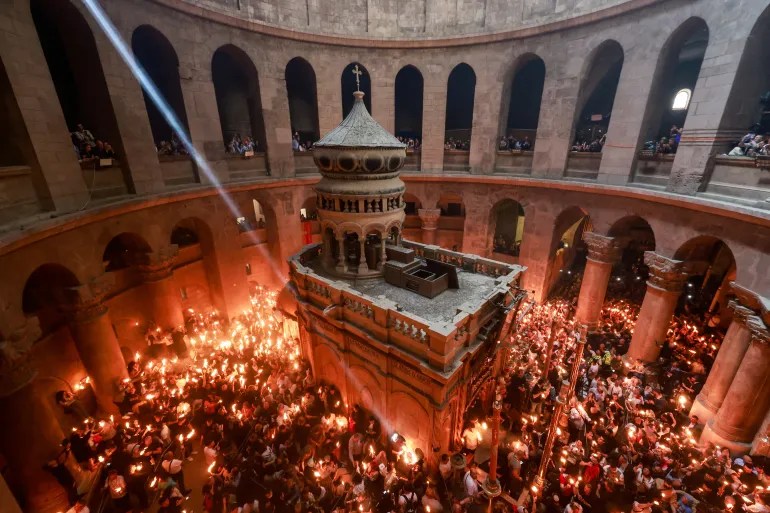
There is much debate over the nature of the “Holy Fire” and its import on questions of miracles vindicating the Orthodox and its alleged failure to likewise appear for Oriental Orthodox and Roman Catholics. There is obvious polemical import for this in hagiographies, just as there is polemical import for those who cite modern Clergy that assert the ignition of the flame itself is not miraculous (though the flame’s inability to instantly ignite hair defies materialist explanations).
Due to the preceding, one can empirically prove that something is going on–at least today. However, one cannot qualitatively equate the past ‘s written evidence with the videographic evidence that now exists. Textual inquiries and videos are two different things, after all. And so, when evaluating polemical hagiographies such as the traditions revolving around sectarian failures to invoke Holy Fire, one needs to approach the written evidence in a fashion fitting the nature of the documentation.
A challenge to the Holy Fire tradition. Whatever the truth of the Holy Fire, which remains for each sides’ faith traditions to affirm and deny, an interesting claim was made by a recent video by “Agen” on one of the polemical accounts of the Holy Fire. In his video, “Exposing the Holy Fire,” a story concerning the Holy Fire failing to appear for the Armenians in “1579” is cited by Orthodox as “proof” that they are the Church vis a vis the Armenians. Agen deconstructs the episode as follows:
The earliest extant form of this story appears much later than the event itself. It is preserved in a Jerusalem Pilgrimage text associated with Ananias and Akakios found in the manuscript of Munich Codex Graecus 346, which was copied around 1634. In this earliest version, the miracle of the split column is described, but there is no mention of the Armenians attempting the ceremony or failing to receive the holy fire. A later version of the tradition appears in Simeon’s prokinitarian [sic] of Jerusalem which was printed in Vienna in 1749. Yet even there, the account still lacks any explicit reference to the Armenians. The explicitly anti-Armenian version of the story does not appear until the 19th century when it is recorded in retellings such as the account attributed to Parthenius. This development reveals how the story evolved in popular tradition. (1:12:30)
Essentially, the claim is made that the Orthodox account is a developing, anti-Armenian polemic of late vintage. This is a conclusion which, despite Agen’s incomplete retelling (as we shall soon see), is true in part. There was in fact an analogous, but essentially true and not fallacious, development in the tradition in the first few decades of the actual events.
The documented history around the original events. Evangelos Nikitopoulos, well known for convincingly vindicating the Dionysian Corpus (see also Part 1 and Part 2), turned me onto an “Eastern Christian” Arabic manuscript on the question of the Armenians. (See AN ARABIC ACCOUNT OF THE MIRACLE OF THE HOLY FIRE (1634) by Father Alexander Treiger.) It is believed to be from an Assyrian (his father is Syrian and grandfather Armenian) and written the same year of the alleged events.
As far as “historical” standards go, this is the “holy grail.” A document written the same year of the events by someone not directly invested in the dispute (though perhaps an Assyrian would sympathize more with the Orthodox than the Armenians) implies it is relatively reliable. A secondary possibility (one I personally favor) is that this may be an “Eastern” Chalcedonian (the perhaps not-defunct Romagyris), as these existed in unknown numbers–considering he calls the Orthodox Patriarch of Jerusalem “most holy” and he identifies himself as a monk of the Monastery of Saint Basil. (121) Nevertheless, Assyrians would sometimes become members of Chalcedonian monasteries for ethnic reasons.
That said, the debate recorded in the document revolves around the Armenians making wrong calendar calculations, beginning Lent one week later, likewise pushing Pascha back another week. This is the polemical context behind the reputed miracle. The source states the following:
This [took place] in the year 7142 from the creation of the world [=1634]…But the community of the Armenians and the rest of the factions have added to their calculus…And they prescribed in their calculus what is different from the calculus of the Rūm. And they thought that their feast was not until April 13, with a week added to the calculus of the Rūm, and they held on to their calculus…As for the community of the Copts, they agreed to follow the calculus of the Rūm, [i. e.] to fast and to celebrate with the Rūm…He [the Armenian Patriarch of Jerusalem] brought them into his presence and intimidated them, and his anger and his wrath increased against them, i. e., [against] the community of the Copts, for they were poor, being few in number in the holy city of Jerusalem, and had no one to govern their affairs. He threatened them with offences and losses that the authorities would inflict upon them if they held on to their decision [to fast with the Rūm]. At that time, their hearts softened out of fear, and they followed his statement and submitted to his speech…Then he came to the Rūm and informed [them] in his statement, saying: “You [go ahead and] celebrate your feast according to your custom, and we will celebrate our feast the following week. You, do the procession and reveal the Light [I.e. Holy Fire], and He who grants you His grace will also grant [His grace] to the rest of us.”… He [the Armenian Patriarch] brought the qāḍī into the Holy Sepulchre, and [the qāḍī] sealed the life- giving Tomb of Christ. He also brought the soldiers of the governor and the soldiers of the citadel, who carried their weapons and their military equipment and had big sticks in their hands. He brought all of them into the Holy Sepulchre, and they surrounded the Tomb and prevented the pilgrims of the Rūm from approaching the Tomb…When it was the ninth hour, at the time when the Gospel testifies that Jesus was hanging on the cross, just as the earth quaked [then], and the veil of the temple was rent in twain, so it happened on this Great Saturday of the Light: the Tomb shook greatly three times, and the interior of the Tomb was illumined with an illumination like the brightness of heaven…And the earth quaked, and some of the [Muslim] guards fell on their faces in fear, while others were looking to the right and to the left. There was a great turmoil, and they said, “True and veracious is the religion of the Christians, and their Light has appeared!” And all of them bore witness…As for the wretched one [i. e., Kīrkūr (the Armenian Patriarch)], when he saw the Light that had appeared, he said to the soldiers, “Hurry and take whatever you wish, and do not allow any of the pilgrims to light their candles,” for everyone held a candle in his hand…When the Franks saw with their own eyes what had happened, they came to believe in the splendid Light, for they had neither believed in, nor acknowledged, the Great Saturday, the Saturday of the Light. They had thought that the community of the Rūm had recourse to a stratagem in this mystery that takes place (they had attributed it to a certain Abyssinian [Ethiopian] who [they thought] would strike fire [with a flint] and light it [and hand it] to the Rūm). Yet, when this mystery hidden for ages appeared and became manifest, they acknowledged it right away. (103-19)
The historical retelling of the event is certainly a vindication of the Orthodox and their calendar, and a condemnation of the temporary Armenian practice. A miraculous flame is clearly being attested to. However, the later tale that the Armenians failed to invoke the Holy Fire and the Orthodox later corrected it is missing, as this would actually contradict the point of the story itself. In short, don’t delay Pascha by a week!
The tradition Agen is critiquing appears to be a conflation of an earlier “failure” (by the Roman Catholics) to conduct a Holy Fire ceremony with aforementioned event that pertained to a calendar dispute with the Armenians. As follows is a Ukrainian document from 1620 recalling the oral tradition of Theophanes, the Jerusalem Patriarch that year (in AI translation) of a reputed Roman Catholic failure that occurred approximately in the 1570s:
During the patriarchate preceding that of the present Theophanes, the blessed patriarch Germanus III [Ed. he recovered the Holy Sepulcher from the Roman Catholics], [the Roman Catholics] treacherously (in a plot) gave a certain sum to the Turkish emperor, the papist monks, who, among other Christian sects, have their own altar in the Church of Jerusalem, had taken possession of the Lord’s Tomb. This [Roman Catholic] elder [priest], having been admitted to the Tomb at a time when the patriarchs were accustomed to withdraw, remained there for a long time—a miraculous occurrence—and, as the fire was about to break out at that customary hour, he pondered the inscrutable ways of God. A flame from the Lord’s Tomb, resembling a stream of water, flowed toward the blessed Patriarch Germanus, who at that moment, together with his clergy, stood—offended, holding a candle in his hands as was his custom—behind the communion rail marble altars, of which there are three there, and [the flame] flowed past. And having miraculously pierced one of those altars right through for eternal remembrance (a crack which is said to be visible even now as if scorched), it lit the candles in his hands and vanished. With such triumph and joy was the marble slab of the blessed patriarch presented to us, and with such shame and disgrace was the [Roman Catholic] guardian of the Holy Sepulcher driven out. As a lasting memorial, three thick iron spikes, shaped like nails, were driven into the pavement and remained there by the Holy Sepulcher. And the Turkish sultan granted the Patriarch of Jerusalem the perpetual right to perform the miracle ritual. (Source)
There have been earlier failed Roman Catholic attempts in Holy Land tradition, but this one dated to the late 1500s in a document from 1620 certainly is the most relevant as it is the most “recent.” Hence, any temporary losses of the site, like in 1634, may have been foggily forgotten and joined to the earlier (and relatively recent) hagiographical tradition.
The fact that the fire in the 1570s actually occurred with the Roman Catholic present and the miracle was where the fire went, not who summoned it, appears forgotten in later retellings. Such details, like the increasingly negative glosses of the Armenian episode, demonstrates that the evolution in the hagiographic retellings surrounding the Holy Fire have polemical import.
Nevertheless, the claim that the events discussed are entirely ahistorical, thereby implying the historical falsehood of the Holy Fire, is an inversion of the actual historical sources. While proving the “historicity” of a miracle does not prove actual miracles per se (sorry Lee Strobel), one can at least honestly conclude that fairly reliable accounts do exist that contemporaries believed Holy Fire miracles did indeed occur. Further, these contemporaries believed that the miracles validated the Orthodox over and against those who opposed them.
The Necessity of Hagiography. The preceding brings out something important concerning how Christians ought to understand hagiographic evidence. Agen’s video rightly is skeptical of the hagiographic gloss of history that the Church uses–presuming upon a materialist epistemology. With a materialist epistemology it is possible that many things about the history of saints played out exactly as our hagiographies record or at least authentically combine elements of histories, such as the preceding. However, we usually dismiss the veracity of claims from other ideologies that fail to provide a more thorough demonstration of their claims than the preceding.
This is when I have to take my Orthodox hat off and put my impartial historian’s hat on–such a hat presumes upon a materialist epistemology. Sometimes the hagiographic conclusion is not by a neutral, materialistic study of history the most likely conclusion. The failed-Armenian Holy Fire probably did not follow the precise order of events later traditions claim, presuming the contemporary document is not a tall tale itself. After all, “fake news” wouldn’t be a term if the dating of the document was sufficient to prove the absolute veracity of its claims.
And so, the video rightly expresses skepticism about certain hagiographic details surrounding the Holy Fire miracle–even if today, being that it does not instantly conflagrate hair, it is empirically proven to be supernatural in certain video-recorded episodes. The present cannot be read into the past as each demand their own scrutiny. But this begs the question–ought we be examining Christian history with a materialist epistemology?
The sort of critical eye cast upon history by employing such an epistemology is no different than how atheists and textual liberals treat the Scriptures. Are they justified in their approach? Being that the Gospel of John literally cites those knowing the beloved Apostle as its author, logic would dictate John did not literally write it. Hebrews does not list an author and mystery surrounded who wrote it in the early Church. Several New Testament books lack wide, early adherence by most accounts. Moses theoretically wrote the Torah and the Lord seems to take this at face value when He cites it; but it records Moses’ death–leading to not just liberals, but even early Church authorities asserting it was re-constituted. 1 Sam 10:25 even makes a reference that implies the rules about kings in Deuteronomy were written during Samuel’s era.
Then there are the outright material contradictions in the Scriptures. They contain numerous, explicit historical contradictions–such as differing genealogies and numbers between Kings and Chronicles. I am not asserting that it is impossible to reconcile these things, but rather with a neutral historian’s hat on, presuming upon a materialist epistemology, I can see how if I apply the same standard the video applies to Holy Fire to the Scriptures, I forfeit the whole Christian religion. I understand that with a materialist epistemology, we can do all sorts of mental gymnastics to resolve these issues in the Scriptures or to draw out a broader point that does not require a one for one reconciliation of the varying Scriptural details. On what basis do we not do this with the hagiographies? God can do all things, their details can most certainly be true or at least true enough to portray some overall point which is actual point at hand.
To those outside the Church, I take my Orthodox hat off and put on my materialist, historian’s hat to make the case that Sacred Tradition has compelling merit from the sources. However, I will also concede to the same people when the evidence, such as in the above, nuances matters. That is, I take care in explaining the overall significance of the available evidence and how it pertains to the hagiographies. What I won’t do, and never do, is use these hagiographies as polemics against people outside the Church. That would be like trying to disprove a Hindu with the Bible. This is why when addressing Oriental Orthodox, I do not cite the Saint Euphemia miracle during Chalcedon despite two contemporary documents making a veiled reference to it. This is because I am aware that to convince an outsider, I need explicit and incontrovertible evidence. The burden of proof is higher and the genre of hagiography tends to lack that kind of evidence.
However, we do not treat hagiographic polemics so exactingly within the Church itself. To the Orthodox, I expect that citing hagiographies and hymns will be treated with the respect and adherence they demand, as by believing them we learn the overall point our Church is intending to teach us. This is why in the Cambodian Orthodox mission, one of our primary priorities is to translate hagiographies.
It is surprising that Agen (representing Coptic Orthodoxy) takes such a categorically skeptical approach to hagiography, similar to Protestant polemicists. Some of my more regular readers may notice is that much of the preceding was already in written in response to a different, Protestant video by Pastor Wallace. Does Agen apply the same, slavishly materialist approach of Pastor Wallace to his own hagiographic tradition? He couldn’t without doubting nearly everything his church teaches about their saints.
We must be honest with ourselves. There is a difference in genre and approach between hagiography and modern historical treatments. Just like we treat the poem of Song of Solomon differently, but no less true, than Paul’s Epistle to the Romans, so to we treat hagiography different than conciliar minutes, or modern secondary sources for that matter.
No one can seriously study Christian history and not come to grips with the fundamental elements of the hagiographic genre. It is, in short, “iconified” history. The authors and translators of the hagiographies themselves are quite aware of this. Like an icon, they portray a literal historical people, but not slavishly and at the expense of not portraying certain theological truths about the same people. Such an apologetic should really be unnecessary to a Christian from an Apostolic church, but out of condescension to modern sensibilities it is worth saying.
And so, hagiography is not quaint and ignorant. It by genre serves a most necessary purpose and it always turns out being correct in its contentions by any epistemic standard, even if this is not the case with every literal detail. Compare this to modern historical treatments which often fail to serve a moral or ethical purpose, even if they tend to be stronger with the details–even in bad histories. Each genre has its own strength and weaknesses, and its own polemical and moral limitations.
Conclusion. Is there a place for a serious critical interaction with sources that meets a vigorous, materialist standard? Absolutely. From the preceding, one can infer that there were contemporary claims to miracles, one of which that implicates the Armenians.
However, applying this same standard, one would be rightly cautious to take hagiography, even contemporary hagiography, and seriously use it as a polemical weapon for those outside the Church. That said, miracles themselves are most compelling and convincing when they meet such a vigorous, materialist standard.
Being that it is not the place of historical inquiry to actually prove miracles, as it is the wrong discipline for that, this would not concern a writer like me or an article like this. I can prove that people at a given time claimed a miracle, but not the miracle itself.
And so, I invite serious critiques and discernment of contemporary claims to the miraculous. I also demand from those who study history to apply equal vigor. But lastly, I challenge my readers to more vigorously and seriously approach hagiography and not treat it as equivalent in every respect to modern histories. Approached appropriately, one may see that in hagiography there is more truth than what initially meets the eye.
 Orthodox Christian Theology