
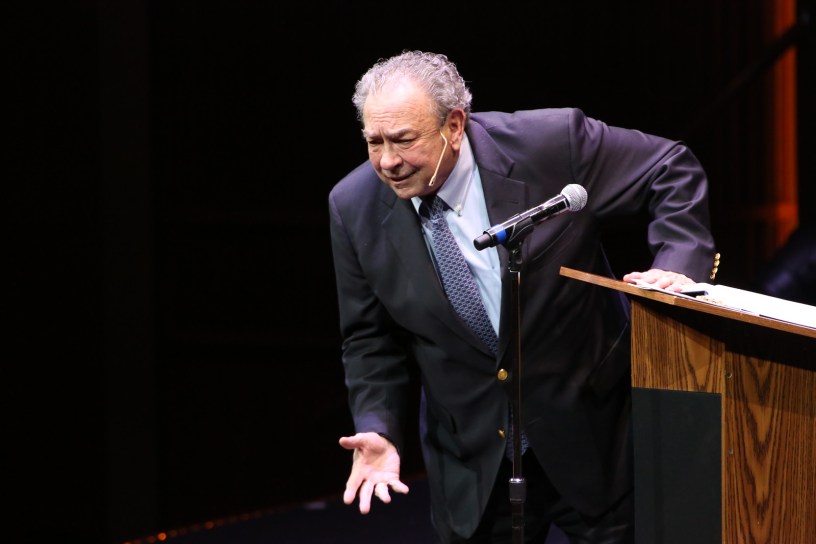
Reformed apologist R.C. Sproul in response to polemical attacks against the epistemic crisis that Protestants allegedly find themselves in because they lack an infallible authority which defines the Christian Bible coined the phrase “fallible Canon of infallible books.” Gavin Ortlund, the apologist behind Truth Unites, has reintroduced this argument to a new generation. This is a much stronger argument than people think, mostly because of the tired epistemic appeals that Roman Catholic apologists make merely cut themselves at the knees (as they would have had the same epistemic crisis for 1,500 years). Where the argument falls short is that both the Protestants and Roman Catholics are ascribing to the wrong paradigm of infallibility, one greatly at odds with Scriptures.
Concerning Gavin Ortlund and his defense of the “fallible canon,” here are my remarks: I am not going to say he is right or wrong, but rather, that what he and his critics expound is incomplete.
Ortlund contends the formation of the Biblical canon is a historical process which God used to help us without a declarative, infallible mechanism. In saying this, he attempts to deny the RC apologetic that you need an infallible magisterial authority to discern the canon from which Protestants theoretically (though not in reality) derive all of their authority. At the same time, by getting “God in the mix” of the history of this formation, we have a practical and moral certainty on the question which does have divine authority. In short, his argument is that because Scripture is prophetic, it is infallible; but, because the formation of canon is not prophetic, it is not infallible but good enough because the historical process had God involved. As I discussed with Trent Horn, we can identify different types of infallible authorities due to the different way God reveals them.
For example, prophecy is infallible for obvious reasons–“thus saith the Lord.” However, things God superintends, such as the Council of Jerusalem in Acts 15, likewise are infallible though they are not prophetic–the Spirit is at work within the historical actors using their discernment. So, Ortlund’s argument that prophecy = only infallible authority is incorrect. The Scriptures clearly showing this not to be the case.
This is why in Ortlund’s historical treatment, he makes obvious errors. His paradigm of infallibility is wrong. He claims that the Council of Carthage which devised their own Biblical canon (which is canonical for Orthodox, amongst other canons, due to Canon 2 of Trullo), but without recourse to them acting infallibly. But, this is not true. Local synods regularly cited that they had “an unerring voice” (Augustine, Letter 51, Par 2; cf On Baptism, Against the Donatists, Book 2, Par 4; Answer to Petilian the Donatist, Book 1, Par 11) or the Spirit at work in some way (Antioch 270, 341). Augustine specified in his view that only councils “of the whole Church” had “the full illumination and authoritative” quality (Augustine, On Baptism, Against the Donatists, Book 2, Par 5) and “a voice that cannot be gainsaid, what has been confirmed by the consent of the universal Church, under the direction of our Lord God and Saviour Jesus Christ.” (Ibid., Book 7, Par 102)
In the continuation council to Carthage 419, which listed the Biblical canon, it even claimed of itself divine inspiration:
For they have ordained with great wisdom and justice, that all matters should be terminated in the places where they arise; and did not think that the grace of the Holy Spirit would be wanting to any Province, for the bishops of Christ (Sacerdotibus) wisely to discern, and firmly to maintain the right: especially since whosoever thinks himself wronged by any judgment may appeal to the council of his Province, or even to a General Council [i.e. of Africa] unless it be imagined that God can inspire a single individual with justice, and refuse it to an innumerable multitude of bishops (sacerdotum) assembled in council. (Canon 138)
Neither the Protestants nor Roman Catholics preserve this understanding of consensus-based superintended infallibility which is in Acts 15, but the Orthodox Church does which is why canonically we have multiple canons–we preserve all of God’s work through His people, the Church, on this question in Canon 2 of Trullo.
My final reflection now drags Anglican apologist ”The Other Paul” to the mix. He claimed in a debate with myself that because there is no infallible list of sacred tradition, it is too vacuous a concept to hold to. This led not only to the absurdity that we (he alleges) do not infallibly know the Gospel of John to be Scripture (by my above criteria, we obviously can and everyone knows the Orthodox are correct about this), but it puts him into contradiction with Ortlund and Sproul who give the only remotely satisfying answer to the Scriptural canon question, even if their apologetic is incomplete.
If Protestants insist their canon is fallible, but this has no effect on moral certainty on the question (I grant the latter, but not the former due to the quibbles above), then they are stuck granting the same to sacred tradition or at least in matters of degree (we have more consensus on biblical canon than on X tradition, and so we are by that degree more certain).
For those interested in the canon question, the best treatment from both the Orthodox and Protestant perspective was between myself and River Devereux where we reached quite a bit of consensus on the question.
 Orthodox Christian Theology
Craig, it is Sirach 4:30, not 4:28. 🙂
NRSV 🙂
Merry Christmas!
Well, it seems the English translations of the Orthodox Bible are different from that in my language. At least in Sirach.