
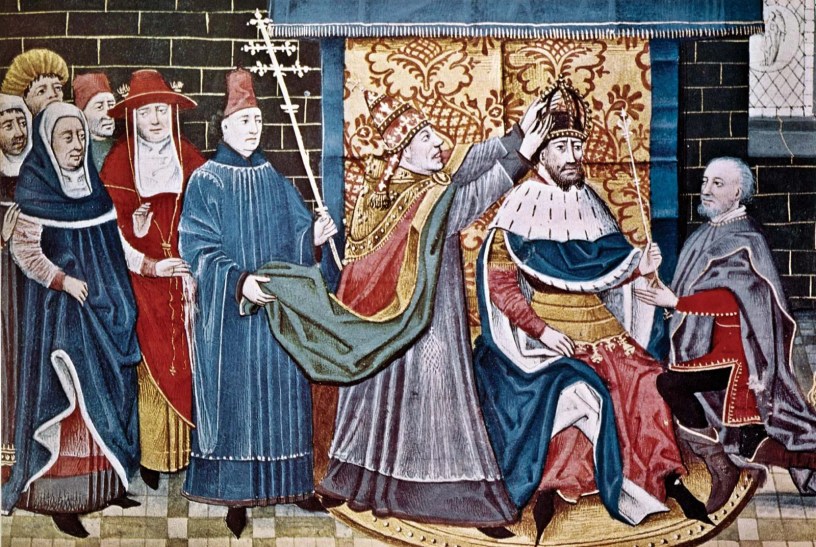
In Orthodox polemics, much is made of Pope Leo III of being a defender of the Constantinopolitan Creed, engraving it on silver–allegedly against Charlemagne. However, he allegedly wrote a letter defending what is perhaps the doctrine of double procession at the behest of Frankish monks in the Holy Land. If authentic, as one German scholar explicitly rejects it and another observes it appears to be a copy of words from Alcuin (written four years after his death and passed off as Leo’s words), it was written about eight years after crowning of Charlemagne in Rome in 808-9 in response to the Patriarch of Jerusalem. It would represent a nadir in Rome as they clearly capitulated on Pneumatology (on the surface) at the Franks’ behest.
One would think the Jerusalem’s Patriarch would have went ballistic after receiving this letter. Indeed, it lacks any attempt at a diplomatic tone. But, this begs the question, in what position was Jerusalem to retaliate against Rome from whom it relied upon for a degree of material support from pilgrims? The Caliphate’s persecutions also made an appeal to Constantinople not necessarily a given. Also, there is no guarantee the letter of the Pope even made it to the Patriarch, as it could have been devised to appease the Franks and never really sent (or “lost” on the way). And so, the non-response of Jerusalem on deciding this question is essentially a wash.
Inveighing against the letter being a forgery is the fact that the Spirit’s eternal procession is entirely clear. Further, the Creed with the addition is not defended, as one would expect in a forgery. Instead, the schema in the letter is about what is common to the divine essence and what is hypostatically different. And so, read plainly in this way, this allows for both a temporal and eternal reading. Leo III’s could have been trying to placate both sides. In refusing to add the Filioque to the Creed itself, he was similarly non-committal–corroborating the authenticity of the letter. It should be noted that Leo II was aware of the Greek view, as Saint Nikeforos of Constantinople confessed single procession in a letter addressed to him.
The only honest assessment of Leo III’s Pneumatology, whether the letter is authentic or not, is that through his vagueries he deliberately refused to stake a claim about hypostatic procession one way or the other.
As follows is an AI translation.
LETTER XV. OR THE CREED OF ORTHODOX FAITH OF POPE LEO
Leo, bishop, servant of the servants of God, to all the Eastern Churches.
We send you this symbol [I.e. Creed] of the orthodox faith, so that both you and the entire world may hold firmly and inviolate the faith in accordance with the holy, catholic, and apostolic Roman Church. We believe in the holy Trinity, that is, the Father, the Son, and the Holy Spirit—one almighty God, of one substance, one essence, one power [i.e. energy], the Creator of all creatures, by whom all things exist, through whom all things come into being, and in whom all things are sustained: the Father, unbegotten and originating from no one; the Son, begotten of the Father, true God from true God, true light from true light—not two lights, but one light; the Holy Spirit proceeding equally from the Father and the Son, consubstantial and coeternal with the Father and the Son. The Father is fully God in Himself; the Son is fully God begotten of the Father; the Holy Spirit is fully God proceeding from the Father and the Son.
Yet, we do not say there are three Gods, but one almighty God, eternal, invisible, unchangeable, who is wholly present everywhere—not divided into parts but wholly present in all things—not in a local but in a personal way. He, without undergoing change in Himself, created changeable things and governs what He created, always remaining what He is, to whom nothing can be added or taken away because the simple nature of divinity admits no addition or subtraction. He is always what He is, whose existence is eternal, who is the same in being, living, and understanding. These three—being, living, and understanding—are one God. These three are the same God and Lord: a true and eternal Trinity in persons, and a true and eternal unity in substance, for the Father, the Son, and the Holy Spirit share one substance.
This holy Trinity is not something different in the three persons together than in any one person individually, since each person is fully substance in itself, but there are not three substances, only one God—one substance, one essence, one eternity, one greatness, one goodness: Father, Son, and Holy Spirit. The Father is not, by nature, different from the Son or the Holy Spirit, nor are the Son and the Holy Spirit, by nature, different from the Father. They share one nature. But the Father is distinct in person, as is the Son and the Holy Spirit. In the Father, there is eternity; in the Son, equality; in the Holy Spirit, the bond of eternity and equality. They are one in substance, essence, omnipotence, and divinity.
Just as this same holy Trinity is inseparable in substance, so it is inseparable in action, although the works of God may be ascribed to particular persons. For instance, the voice that came from heaven over Christ during His baptism is ascribed to the Father; the assumption of humanity pertains only to the person of the Son; and the dove, in whose form the Holy Spirit descended upon Christ according to His human nature at His baptism, pertains specifically to the Holy Spirit. Yet, without any doubt, that voice and that dove concerning Christ’s humanity were works of the whole holy Trinity, whose actions are indivisible.
We believe that the same Son of God, the Word, was eternally begotten of the Father, consubstantial with the Father in all things, and was temporally born of the Holy Spirit and the Virgin Mary, possessing two nativities: one eternal from the Father, the other temporal from His mother. This same Son of God, conceived in His flesh, was born in His flesh. We confess Him to be true God conceived and true God born, the same true God and true man, one Christ, the only-begotten Son of God, perfect in both natures in the singularity of one person: impassible in divinity and passible in humanity, mortal in our weakness yet immortal, crucified in our frailty, yet ever living in His strength. He died the death of His flesh, was buried, descended to the underworld, condemned and despoiled the prince of all iniquity, rose again on the third day, and ascended into heaven in the sight of His disciples in triumphant glory. He sits at the right hand of the Father, in the majesty of divinity, from where He will come to judge the living and the dead. The wicked will see Him judging in the form in which He was crucified—not in the humility of His unjust judgment, but in the glory of His righteous judgment of the world. The eternal vision of His majesty will be the blessedness of all the saints.
Whoever does not believe according to this true faith is condemned by the holy, catholic, and apostolic Church, which was founded by our Lord Jesus Christ, to whom be glory forever. Amen.
 Orthodox Christian Theology
The desperate hypothesis of Alcuin’s use of a Fides sent by the pope would be contradicted by the fact that, when the matter of Mount Olivet arose, Alcuin had been dead for four years. The idea of a reuse by Leo III of a Fides from Alcuin is no more acceptable: one cannot see the pope sending, for information, to Charlemagne, without a word of explanation, as if it came from the Apostolic See, a formula composed and edited shortly before by the emperor’s minister. Therefore, what the symbol sent by Leo III to Jerusalem and Aix-la-Chapelle said about the procession of the Holy Spirit remains unknown to us.” (Acts of the Synod of Aachen 809, pages ca. 25-27)