
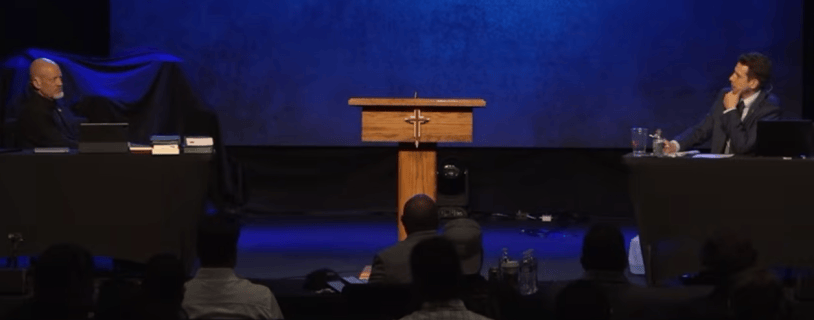
Greetings readers. Forgive me for being much more casual in tone in this blog post. My hope is that it may defuse some of the negativity expressed by Pastor James White since our wonderful debate on iconodulia that he and his friend’s church was so kind to host.
In consequence, this is not a refutation nor a relitigation. In the spirit of peace I will not go tit for tat and not address categorically address all of his concerns ranging from Evangelos Nikitopolous’ and mine peer-reviewed research on the potential authenticity of the Dionysian Corpus (parts I and II), the nature of cumlative arguments based on low-probability potentialities, and his consternation in not finding a iconodulic interpretation of Gal 3:1 in Orthodox sources as late as St Theophan the Recluse and even the contemporary Orthodox Study Bible.
It is not that all of these concerns are not interesting and worthy of some response. I’ll say in short I don’t think I made low probability arguments (especially considering the degree of scholarship of Christian art’s usage) and as for the Dionysian Corpus, I welcome another debate on exactly that topic. His article (which he was kind enough to share and whose serious interaction is much appreciated) is certainly far from the last word on the subject–and in fact fails to make its own strongest case, as Nikitopolous two years ago had added a footnote on Jerome, if not neglected by White, that would have strengthened his own case–but I digress.
I do want to take some time to discuss the topic of Scriptural exegesis more generally. His debate and subsequent comments at his Youtube Diving Line show found at the channel Alpha and Omega Ministries express significant concerns about Gal 3:1. Looking into his eyes during the debate, I think this Scripture had a significant effect upon him. He is genuinely concerned. Hence, I think addressing his concern can be of some real benefit to him, and others.
In this article, I am not going to exegete the passage again. I already justified my exegesis during the debate, and had further cited two modern scholars with name, title, and page number acknowledging the iconodulic exegesis. Because he has yet to address the basis for my exegesis or refute the points of the scholars I cite but rather dismiss them, I do not see how it would be in good taste to pile on and get deeper into exegesis at this juncture. I do feel it is worth adding, because it was stated during the debate that citing Strongs is inadequate when discussing etmology, to point readers to Bruce Longenecker’s 1999 article which provides extensive etymological comments on “the evil eye.” This is something extremely relevant to the apotropaic emphasis that I cited during the debate which I gleaned from his 2015 book The Cross Before Constantine.
With that said, lets now shift to White’s surprising concern about Orthodox Christian Scriptural exegesis–something he has only begun seriously investigating (at least, at the level of debate). White has questioned whether the interpretation of Gal 3:1 that Wright, Longenecker, and myself provide has any basis within the Orthodox phronema. I am not sure why a Baptist pastor would care to know, but being that he asks Gal 3:1 bares mention in the iconodulic polemic of Saint Theodore the Studite. Further, Ambrosiaster provides a very literalistic interpretation of the text which likewise appears icondulic, because despite it not conciously opposing any sort of iconoclast it simply takes for granted that readers are responding to what they would see on a crucifix. The interesting facet of Ambrosiaster’s Latin is that he clearly understands “publicly portrayed” as not a matter of writing or speaking, but of imagery–an important quibbling if one gets into the etymology of the original Greek terminology and how it was rendered and understood in the Old Latin New Testament (pre-Vulgate). But, I digress again.
I don’t anticipate that two mentions are sufficient enough for White or anyone, including myself, to say that this is a majority New Testament interpretation of the Church. Quite frankly, I never considered proper Scriptural exegesis as a “popularity contest.” This brings me to my point: That is NOT how Orthodox to Scriptural exegesis.
For some reason there is a misapprehension that in place of a rigorous interaction with the text of Scripture, Orthodox exegesis requires a torturous citation of the saints (mainly Saints John Chrysostom and Theophylact of Ohrid) and no further explanation of meaning beyond what they tell you the passage means. This is not how many popular Orthodox priests in the Old Countries, such as New Martyr Daniel Sysoev (whose Scriptural commentaries are extensive), interpret Scripture. It is not how my own Scriptural commentary on the Book of Job, Fellowship With Christ’s Suffering, interprets Scripture (13 five star reviews, not bad for a self-published book!). Spiritual writings from all sort of recent Orthodox writers are similar in this regard. Scripture is interpreted quite freely and previous saints are often consulted for additional insight.
White is a professor of Church History. He is certainly aware that Chrysostom, Jerome, Marinus Victorinus, Amborsiaster, Origen–the most widely published early exegetes of Scripture in the early years, at no point are slavish in their exegesis. Chrysostom, Jerome, and Origen may be set apart that they often make comment on what they find to be manuscript issues with texts. In Chrysostom’s case, he often makes explicit comments about what he disagrees with about earlier interpreters (whose names he often leaves unsaid so as not to impugn them, though that is tantilizing for us reading him now!). Later writers, like Gregory Palamas, similarly take a free approach to interpreting the Scriptures and often disagree with earlier exegesis (such as on Gen 6 and the “sons of God” giant speculations that persist to this day in Protestantism). Years beforehand, Saint Maximus made an oft-neglected point: “[T]hings signified in Scripture, according to the possibilities inherent in the Hebrew language, in fact have multiple meanings, which is exactly what we find here in this passage.” (QT 64.3) By multiple meanings, what he is referring to is multiple interpretations. And so, he does not feel he is contradicting anyone when he gives a new interpretation of a passage, or a new typological inference.
Orthodox apply Maximus’ principle today, even in the West where our English-language resources are still poor. We commonly typologically interpret Jacob’s Ladder to be the Theotokos, when Christ Himself says he is the Ladder. It is a double meaning. But Protestants do this too. Emmanuel from Is 7 is Christ of course, but it is also Isaiah’s son born in Is 8. Double typology, because it is something we commonly accept, already requires as a matter of premise that Scriptures can have more than one meaning and application. For Sola Scriptura this is a real problem, because there is no governor as to how “out of the reservation” one can get if the very grounding itself can mean multiple things. But, in Orthodoxy, there is a different interpretative paradigm pertaining to Sacred Tradition. This means, I, you, or anyone can interpret the Scriptures however we want and as critically as we desire, but our governing principle is to submit ourselves to that Tradition.
I am very aware that this is precisely the sort of thing that is considered eisegesis by Protestants. This explanation will not satisfy itching ears–but, it is the truth. The truth now plainly stated, one must ask does this then eliminate truly vigorous Scriptural exegesis? I don’t think so. It just gives us a measure in which to evaluate our conclusions. Magisterial Protestants already follow the principle, whether they admit it or not. They don’t read Prov 8:23 and despite the meaning of the Hebrew assert that Christ is created. Most infer homoousias despite the term not being found in the Scriptures, but in earlier councils (specifically Antioch 268 where it was used positively and negatively and Rome 260; something that Eusebius, Athanasias, and Basil all observe).
Alpha and Omega Ministries quotes Richard Muller stating, “Sola Scriptura was never meant as a denial of the usefulness of the Christian tradition as a subordinate norm in theology….tradition was a useful guide,” etcetera. It does not place a Sacred Tradition on top of Scripture, something that arguably is in fact the case in Orthodox Scriptural exegesis though we would view it as part of a holistic whole as opposed to Scripture being made inferior. That said, it shows it is not out of left field that both Orthodox and Protestants have some sort of umpire that calls exegetical balls and strikes. Orthodox ideally listen to their umpire (tradition) when exegeting. Protestants, to paint with a very broad brush, can individually decide when they want to be their own umpire. How well baseball works in the latter case, I’ll let the reader decide, but the very art of pitching does not change.
I can throw a tried and true two-seam fastball, employ the most popular exegesis, and as long as I don’t put any sort of heretical wrinkle on that pitch the makes it drift out of the zone it is a strike. But, if I am Saint Maximus (just try reading his anagogical exegesis!) and throw a knuckleball, it being nothing like any other pitch in most pitcher’s arsenals–as long as it lands in the zone it’s likewise a strike. Ultimately, does a Anglican fault a Baptist for a seemingly novel Trinitarian exegesis which withstands etymological, textual-critical, and contextual scrutiny? Of course not. Biblical scholars would have long ago quite releasing commentaries if this were the case. This is because we all buy into the concept of exegetical balls and strikes.
And so, with Gal 3:1 the issue here is not how I went about my exegesis, which is more than justified, but that Pastor White and I don’t share the same tradition. To him, my curveball is out of the zone. In fact, his appeal to Orthodox sources for my exegesis implies an awareness that there even is an “exegetical strikezone.” This is why I have already demonstrated that within an Orthodox context, I threw a dead-to-rights strike. My exegesis withstands etymological, textual-critical, and contextual (hence the emphasis on the evil eye and the cross’s apotropaicism) scrutiny. I’m also not the first person to infer it.
I feel the preceding moves the conversation forward enough to anyone out there is actually listening. I’ll end my comments here and commend White and my readers to reflect upon these things.

