
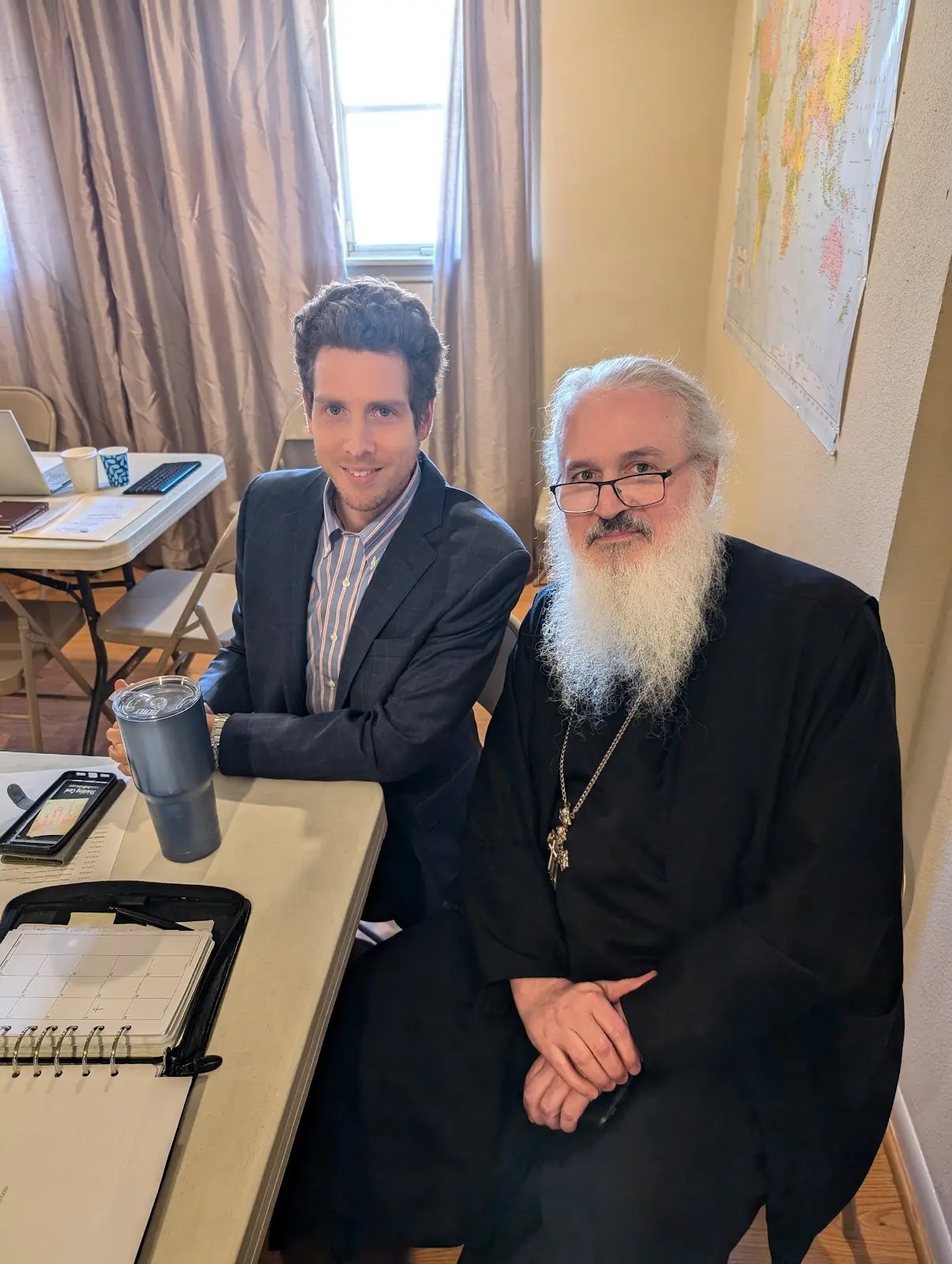
I am just a run-of-the-mill Bible-reading, church attending layman.
As a matter of public knowledge, I have a general blessing by Bishop Luke of Syracuse to write and to encourage people to become Orthodox and to make clear this does not mean any view of my own is blessed by him or is his, but rather they are my own.
 Orthodox Christian Theology
Hey, Craig. Listen, I’ve been having some trouble sleeping recently. Could you send me a copy of that East West Journal article? lol
Love you, brother.
Pastor
Hi I saw you post at Shameless Popery yesterday and came to your blog to see what you were interested in. I blog at Nick’s Catholic Blog where I “specialize” in addressing Reformed Theology (with an emphasis on the Book of Romans), and I think you might be interested in some of what I’ve written. I believe the issue between Protestants and Catholics comes down to Paul’s teaching on Justification, with everything else being of secondary importance. I have written a lot on the Biblical definition of Justification, Righteousness, “Clothed” with Christ, Penal Substitution, Imputation (Logizomai, look it up if you haven’t!), and Active Obedience. I stick to Romans and Galatians as much as possible.
If you want a background on Romans (so you can see what I have been focusing on) check here: http://christianreformedtheology.com/category/a-catholic-flavored-commentary-on-romans/
Please post a link to that blog.
GOd bless,
Craig
Hello Craig,
Sorry I didn’t get back to this earlier. I’ve been very busy with life and for some reason WordPress hasn’t been sending me updates telling me new comments have been posted, so I didn’t know unitl I just checked. Now as I try to respond here, it wont let me post links.
My blog is CatholicNick at Blogspot, and should be an easy Google Search. I cover key texts like 2 Cor 5:21, Rom 4:3, 4:6, etc, and show how Sola Fide is impossible on an exegetical level.
Life gets busy. If you would like to pint any articles in particular I can look. I already responded to an article about Leviticus you wrote here: http://christianreformedtheology.com/2015/10/10/animal-sacrifice-leviticus-and-penal-substitution/
I would be interested in any specific comments you ever have. God bless,
Craig
Hmm, I guess the comment did go through and it looks like you found my blog.
If I had to point to my absolute favorite article I would point to “A Study on Imputation of Righteousness.” It’s somewhat long though, but that’s because I document about 50 Reformed Scholars who completely err on a key Greek term “Logiomai”.
Also my “Romans 4:6-8 crushes Calvinism” (June 5, 2013) is a go-to apologetic for me.
Finally, as to not over load you with reading, I’d simply suggest “Is Imputation taught in 2 Corinthians 5:21?”
I’ll comment on your Penal Substitution post you made last month.
Give me some time on that, I have been teaching through Job and it has been taking away from even time I have to post my commentary of Romans (which is already finished!) Keep up on me 🙂
Hi Craig, you wrote that you converted to Christianity. If you don’t mind my asking, what sort of background were you previously (though I have an idea)?
Hey Craig,
My name is John and I’m actually a follower of Joe’s blog at ShamelessPopery, and I see you commenting there rather frequently.
I just wanted to commend you on your patience and respectfulness, as well as your intellectual honesty, when you dialogue there. A true demonstration of Christian charity! “Love is patient, love is kind…” I see that not all the Catholics who comment there give you the same courtesy (not speaking of Joe himself), and I think that’s their own problem.
In my own subjective experience, I’ve seen so much online discussions where people from both sides just yell religion at each other, being both passionate and ill informed. Thanks for being a breath of fresh air. I wish there were more people like you. It would make discussing our differences so much more edifying.
Keep up the good work and God bless you.
John
Thank you for the kind words, I am not always such a great example of what you write of but thank you for letting me know that men like you have an eye on me 🙂 Christians must be known by how they love one another.
God bless,
Craig
Hi Crqig,
I was wondering if you had studied/read about when the change took place in regards to “representing Christ” during the Eucharist? My understanding, limited to scant gleanings from a few websites, is that the change took place mid to late 4th cent., but I have not been able to confirm this with any certainty. The Eucharistic Sacrifice, from what I understand, in the early church was limited to receiving Christ’s finished work on the cross and offering praise, thanks, and oneself, not Christ. Any information and sources you may have would be greatly appreciated.
Scot
Thanks for the question. In short, the idea that the Eucharist had a propitiary effect has its earliest support in the antiochene liturgies. See https://christianreformedtheology.com/2015/11/16/development-of-the-term-unbloody-sacrifice-in-the-antiochene-rites-early-liturgies/ The earliest of these liturgies is probably from the early fifth century. The Liturgy of Saint Chrysostom, which is probably from the 5th or even 6th century, is the earliest I have found with the notion of the Eucharist forgiving sins.
However, early CHristians did believe that they literally received Christ in the Eucharist. Both Justin Martyr and Ireneaeus were explicit about this fact, Ignatius debatably so.
God bless,
Craig
Hi Craig, I’ve been reading your blog for a couple of months now. I just read that you aren’t a Protestant anymore and that your are a catechumen for the Orthodox Church. Do you have any article in which you explain your change of mind/testimony? I currently am a Protestant but leading towards Catholicism. There are still some things that are keeping me from converting (such as family) but I see my conversion in a future.
Regarding Orthodoxy, do you have any particular book suggestion? Mainly on its doctrine and history. I’d like to know your reasons for converting to Orthodoxy and not Catholicism.
Hope you have a great day,
God bless.
There are not a lot of “great” Orthodox books vis a vis Roman Catholicism . The best all around treatment I have seen is “Light from the Christian East: An Introduction to the Orthodox Tradition” written by a Lutheran scholar. As for why Orthodoxy and not Catholicism my reasoning is two fold. First, I find that Orthodox soteriology is much more explicit Biblically and traditionally than the highly merit-based Catholic system. Second, Roman Ecclesiology is historically a minority, and peculiarly Roman view (big surprise.) It was never an ecclesiology adopted by the East and it was specifically rejected as early as Cyprian, and emphatically so. Please stick around as I will be having articles on this subject coming up, though my contributions will hardly be the best work ever done on it.
I did a Sola Scriptura debate with Matt P., a Catholic, and I think the weakness of the Roman position is very clear. In the debate I do not argue the Protestant view of sola scriptura, but rather against the Roman view of authority (Roman Supremacy.) Personally, though I love him and owe my conversion to his efforts, I think Matt’s arguments are weak–ultimately minority Scriptural exegesis and well wishing. Hardly a compelling view if we want to adopt the historical mode of understanding the Christian religion that Christians have always understood.
Please stay in touch,
God bless,
Craig
Hello, Craig. After almost three years investigating the claims of Catholicism, I am becoming, God willing, an Eastern Orthodox soon. I’m flying back to my home country after living in Dallas for five years, getting my degree in theology, getting married and having a daughter. I’m just writing to let you know that your writings have helped me a lot. If you’d like to know more about me, I can message you on Facebook, if that’s ok with. I’ve decided to keep my identity anonymous on public sites. God bless.
By all means facebook message me. Love to know where you plan on going to seminary. May God bless you.
Craig, a valid priest can absolve us from our sins. This is simply wonderful, the good news! As you prepare to approach the Eucharist, I hope that you do not come as an anti-catholic, or anti-anything. Our mother Maria can help you in your discernment, catholic or orthodox. There is no better help. She is the mother of all baptized – ask her. There is a book by Saint Louis De Montfort on true devotion to Mary. I hope it is helpful to you. In the end, going to confession and being absolved from sins is what matters. God bless you!
Than you for the reminder not to be anti-catholic. I want to be careful not to be anti-anyone, and the prayers of Catholics and Protestants mean very much to me.
Craig, I am thankful for your blog. It is helping me mentally reconcile some of the conflicts I am having between my decision to pursue joining the Eastern Orthodox Church and my own sympathies to the Reformed tradition. I do have a question. How do you reconcile your own legacy Reformed beliefs (such as limited atonement, predestination, unconditional election, basically TULIP, etc.) with the Confession of Dositheos?
Will respond in detail please pester me
Hi Craig! 🙂 This is Annalia Fiore from RMBC. I’m leading a presentation on Theodicy in the Brothers Karamazov, and I was wondering if you knew of any early church/patristic writings on the subject? 🙂 I hope you and Knoch are doing well.
Annalia, it is so good to hear from you! Noch sends her love!
I’ve begun reading the Brothers Karamazov and for now, I am not seeing the Theodicy portion of it yet…so I do not know the paraidmg the book is working under.
Theodicy itself is a surprisingly sparse topic in the patristics itself. I have found Augustine to be the most thoughtful writer on the topic. In the Confessions, in Book VII he gives a repudiation of the Manichees who ascribed evil to have a substance. You can begin in Chapter 3 (https://www.newadvent.org/fathers/110107.htm).
In City of God Book XII, Augustine also speaks of the subject, ironically also beginning in chapter 3 (https://www.newadvent.org/fathers/120112.htm).
Tertullian, an earlier writer, in Against Marcion Book I anticipates the later “permissive and prescriptive” wills of God as talked about by John of Damascus. Conversation begins in Chap 26 https://www.newadvent.org/fathers/120112.htm.
Saint John of Damascus’ treatment, specifically in Chap 28 of Book II of his Exposition of the Orthodox faith gets into more detail about the permissive and prescriptive wills: https://www.newadvent.org/fathers/33042.htm
Saint John Chrysostom also gives a treatment of the topic in his exegesis of Rom 7:13–found here: https://www.newadvent.org/fathers/210212.htm
Personally, I think Augustine’s treatment here is overly pedantic and concerned with refuting Manichee doctrines (they were Gnostics and saw evil as something created and material). Augustine gives a far better, and Biblical, treatment in the Handbook of Faith, Hope and Love (https://www.newadvent.org/fathers/1302.htm). This one has some good “one liners” but its well worth reading from top to bottom, it covers everything on that topic.
If I can offer any closing comments, the early church fathers’ take is that:
1. Evil is not a “thing,” as in it has no substance and is not created. God made everything “good.”
2. On that note, God never wills evil. He only wills good.
3. When evil exists, its origin is in the perversion of the will. So angels and men, who turn their will against God, take what is good (free will) and do evil.
4. God permits evils existence, for a good purpose. (Augustine really is the only father to really grasp this well in my honest opinion.)
Now, some of this really does not explain why there are cyclones and viruses, as the perversion of our will has led to material creation being subjected to futility. I am not sure if a father has addressed specifically this, though I would venture to guess that because creation was put in man’s care in Gen 1, the perversion of his will has destroyed everything under his care–just like a husband and father, leaving a household badly, ruins the household.
God willing, this all helps!
My wife and I miss you and your family dearly. With this Covid stuff, who knows when we will be downstate next. But it has been too long. Please send our love to your family. And if you guys ever go upstate, please PLEASE don’t be strangers.
God bless,
Craig
Craig, thank you so much for these resources. These are IMMENSELY helpful. I’ve already passed them on to my classmates.
The Brothers Karamazov is a fantastic book, and the subject of Theodicy is introduced in chapters Rebellion to the Grand Inquisitor. 🙂
(On a side note, I’d love to see you write an article on the Orthodox interpretation of Romans 9. That’d be fascinating!)
My parents send their love. And congrats on your new little one!
I forget if your dad has Facebook or who I can email to send some pics. Would Jonathan mind if I send them to him and he can send them over?
Craig, thank you so much for these resources. These are IMMENSELY helpful. I’ve already passed them on to my classmates.
The Brothers Karamazov is a fantastic book, and the subject of Theodicy is introduced in chapters Rebellion to the Grand Inquisitor. 🙂
(On a side note, I’d love to see you write an article on the Orthodox interpretation of Romans 9. That’d be fascinating!)
My parents send their love. And congrats on your new little one!
My dad says “you can email him at — his name at his last name (plus an “s) dot org.” 🙂 We’d all love to see baby pictures.
Hello Craig! My name is Juan David and I’m glad that I have found your blog, and more right now that I have converted to Christianity. However, I have no denomination yet, since I accepted that there was one true God who came down to earth, and well, the rest is what we all know. During this time, I’ve been studying and reading about Christianity and its thousands of denominations, but I have felt attracted by the doctrine and beauty of Orthodox Christianity. The first article I read was the one about Eucharist that helped me to understand more that Jesus was actually there and what Jesus meant by saying “do this in remembrance of me.” Hope you keep helping me!
Juan, I will pray for you. Pray to God to help you and seek to please him. I recommend fasting, prayer, and Scripture reading. Let me know if there’s anything I can do to help.
God bless
Hello Craig. Thanks so much for your website and for everything that you’ve been doing since you converted to Orthodoxy, I can’t tell you how much your worked has helped me spiritually and intellectually. I’d be incredibly grateful for any help with my struggle: Despite my great desire to be received in the Orthodox Church, I have run across the most difficult and grave stumbling blocks. They were completely unheard of in the Church just 70 years ago, and are extremely relevant not just theologically but for the practical moral conduct of the everyday orthodox christian. They shouldn’t cause concern just to the “repressed”, “OCD people” and “zealots”, as we are consistently accused from “orthodox” circles. I’m referring to the flat out moral cave ins within orthodoxy on contraception, masturbation and in vitro fertilization. Let me be clear that I’m not scandalized nearly as much by the number and ecclesiastical status of those who hold to these morally heretical propositions, as I am by the lack of open resistance and sheer outrage on the part of those who hold to the Tradition of the Church. What’s the spiritual meaning of this and how does it fit with the holiness and infallibility of the Church?
On contraception: Their logic of its defenders (who are legion everywhere in orthodoxy, for example the OCA synod) is that the unanimous, firm, explicit, intransigent (even in cases of rape) consent and practice of the Church for 1950 years doesn’t apply because science. But the incredibly strong condemnation is unanimous in the fathers and universal practice of the church, witnessed, e.g, in the penitentiaries through the centuries. If this has not been received by the Church then nothing has, introducing an ludicrous level of subjectivism. With this subjectivism and novel and perverted use of the concept of oikonomia, it’s not surprising it didn’t take long before…
On masturbation: Defended sparsely, but consistently and openly by various clergy in the last decades. But nothing can beat the scandal of the statements by the The Holy Synod of the Church of Greece, 2007, Basic Positions on the Ethics of Assisted Reproduction (found here: http://www.bioethics.org.gr/en/Assisted%20Reproduction4l.pdf):
“Sperm is obtained in ways that are neither natural and nor ethical. It results from orgasm without normal sexual intercourse, a fact that insults the sacredness of the reproductive function. However, when the aim is childbearing, this act cannot be considered as a sinful act of sperm loss, provided it is performed in ways that do not disgrace human dignity. Nevertheless, it requires special sensitivity and attention.”
Notice the contradictory, “vatican II style”, compromising parlance so typical of modernism, complete with a reference to “human dignity”, apart from how the moral tradition of the Church has always understood it of course.
And on in vitro fertilization, the same document says: “The Church should eagerly suggest adoption as an alternative to those couples that are unable to accept, for various reasons, their sterility problem. If this is not possible, then She could accept, within the spirit of Her dispensation, fertilization techniques that do not involve surplus embryos, or include any form of donation or embryo destruction… She could also accept assisting the reproduction procedure by using only the parents’ gametes and fertilising as many embryos as will be implanted.”
Thus effectively signing the death sentence of God knows how many embryos in the hopes that one of then will be successful (rate of success much, much, much lower than in natural conception), not to mention the fact that it’s taken completely out of the context of marital relations.
To be away from the Church is a very painful situation, but I would’t bear this if not for exceedingly serious reasons. Thanks so much for the attention.
Regards,
Pedro Felipe Rabelo Almeida
I agree with your sentiments. And, I have no magic wand to fix the problem than to point out it is frequent in Church History (and even Biblical times) that the majority of the Church has problems.
That being said, I have seen even liberal priests (and even a Bishop from a liberal jurisdiction) admit that all those things you point out are in fact sin. In Russia, they are moving to illegalize in vitro, which is interesting being that only the CHurch is really behind this. So, the real problem ultimately is lax spiritual disciplines and its starting to drip its way into public teaching.
Our job is to push back and let God sort it all out.
God bless,
Craig
In relation to my last comment, the Orthodox Church takes communion seriously, how long can this situation endure? I see no precedent in Church history, even the most widespread heresies (monothelitism, arianism) faced vigorous, if at times small, resistance on the ecclesiastical level.
The issue would be how many bishops are really subscribing to this. It was probably always weak at the parish level where you are dealing with people and their messy lives.
What scares me is the ecclesiastical consent and silence from the opposition on these things. A Holy Synod of the Church of Greece deliberation, translated into Russian, French and English, that being only the tip of the iceberg, and no recent opposing ecclesiastical deliberation I can point too? Why do even the “Genuine Orthodox”, who are all up in arms about ecumenism, Sergianism and Modernism on their official statements, don’t do anything at all on an ecclesiastical level when it comes to these grave heresies? In fact one of them claimed as if it was a positive thing that their bishops are united in the usual consensus that contraception is permissible under certain cases through economia. “Where the bishop is, there let the people be, for there is the Catholic Church”- Saint Ignatius of Antioch. Can we really say the some about our hierarchs today? I can trust nothing that comes from them at this point, I say this in terrible sadness. These things are just spiritual venom, and this cannot possibly be a normal situation in the life of the church. Maybe it’s my ignorance, but I see nothing remotely close to this situation in Church history. Even the vast majority of heretics made sure they appeared before the people as having a high moral standard. Sorry for writing too much, thanks so much for the attention.
Best regards,
Pedro.
This consent is not widespread, though the silence is. Take Monotheletism. For a period of time, every major Patriarch fell under it–including Rome and arguably Jerusalem (though traditionally the bishopric was “vacant” due to the Arab invasion.) Did Christianity disappear? Sometimes true teaching hides in the fringes, with a few faithful Bishops. I am grateful to kow a few, and interestingly sometimes these bishops are publicly different than their private convictions as they play a careful political game.
I think Satan is tempting you and making you dispair. As I teach my employees, tell yourself, “Not my problem.” You should worry about your own faith, your own humility, your own love of God.
Please pray for me.
Ps 131:1 Lord, my heart is not [a]haughty,
Nor my eyes [b]lofty.
Neither do I [c]concern myself with great matters,
Nor with things too [d]profound for me.
2 Surely I have calmed and quieted my soul,
Like a weaned child with his mother;
Like a weaned child is my soul within me.
3 O Israel, hope in the Lord
From this time forth and forever.
Thanks so much for your responses Craig, I will meditate greatly upon them. On a side note, have you come across any material in church history that would help one to averiguate to what extent abstract christological heresies like Monothelitism was preached to and affected the populace, as opposed to being restricted to a more or less scholarly discussion? The former seems to be the case of the three sins I mentioned, as they’re widely adhered to.
Please pray for me as well.
Best regards,
Pedro
I honestly think the populace were not too involved with the Christological heresies outside of hotbeds in Egypt and the Middle East. This is why as soon as Byzantine policy turned against it, it disappeared without a trace.
Hi Craig – saw you on with Tim debating the filioque so wanted to check out your site. I am 50 and converted from Catholicism to Orthodoxy seven years ago. I was married in the Catholic Church and divorced and remarried before my conversion (I lost my way for a while). My priest is wonderful and he is certain my divorce is not something that will keep me from salvation. However, being born and raised Catholic I really worry that it will. Do you have any opinion on that? I know that the Orthodox allow divorce and remarriage in certain circumstances, but the Catholic stance really, really, worries me. Any insight or if you know of any literature that addresses this, would be very helpful – Mike
Mike, I hope all is well. Of course, you should ask your spiritual father how you should atone for any past sins.
As for the history of divorces, the Church has sadly always them in the east and west. Here is a good resource:
interesting to peruse the comments, the majority of which seem to indicate that upon study and personal ‘conviction’ a certain denomination or system of belief should be followed. most of this though is based on what extra-scriptural sources opine regarding God’s will. i am – as far as possible, a Sola Scriptura guy who, in my relationship with the living Jesus Christ, follow Him as my sole tutor. much is said of ‘christian’ and ‘Christianity’ on this page, but the person of Christ, the crux of everything, seems to be sadly missing.
This page has become mostly church history, and not Scriptural exegesis. It may return to Scriptural exegesis some day as I am Orthodox longer.
i am looking forward to that for as you know focusing on Christ saved the drowning peter, not church history 🙂
Ironically, I just wrote something today which is chock full of Scripture (it explains Orthodox soteriology.) Ironically, its probably for another website.
link please
in Christ
gabriel
I cannot send it out yet, but have you seen this? https://orthodoxchristiantheology.com/2020/06/19/the-prelapsarian-mind-a-biblical-exegesis/
Hello Craig,
I’ve come across your blog through your interviews with Sam Shamoun on YT. I am an apostate from Islam and have accepted Christ as our Lord and Saviour, and one of the main issue I have to decide is which Church to be baptised into. I am attracted mainly to the Eastern Orthodox Church as it seems to have the right view vis-a-vis the Filoque, for there sure can only be one source of divinity, though I must admit I am still lacking a sure-footed philosophical basis to be completely sure, and because of the traditionalism it cherishes and protects.
I would like to have some book suggestions with which I can further study this issue and which can introduce me further to the Orthodoxy.
Cheers.
Sayed, the best catechitcal source from Orthodoxy is Law of God from Daniel Sysoev, a 21st century saint.
I recommend you begin reading pre-schism prayers in the morning and evening. Also read the New Testament every day. Fast on Wed and Friand I think God will clear this issue up for you.
Here are morning prayers: https://www.orthodox.net/services/morning-prayers.html
Here are evening prayers:
https://www.orthodox.net/services/evening-prayers.html
God bless,
Craig
Dear Craig,
Thank you very much for the book recommendation, advice and prayers.
May God bless you too.
Sayed
Dear Craig,
I had not seen your work but came upon it today when someone sent me the video you did months ago in response to a letter from the DOS about our work. I thank you for the video and your sensible review of the letter in question.
The Lord bless you and your family!
In Christ Jesus,
Fr. Peter
Thank you Father for your prayer and also for all your work. Fr Chris is putting together that book on St Gregory Palamas and the Filioque and when he copied you on the conversation, I was confused and thought you had actually responded, so I apologize that in the video I make reference to a disagreement on Augustine (it was actually Fr Chris.)
Let me know if there is anything I can do to promote or help. Otherwise, I will pray for your work.
All the best,
Craig (Patrick)
Patrick, The Lord less you and your work! Thank you for your reply, explanation (I didn’t know about that; no worries), and your offer to assist. Your prayers are very welcome and gratefully received.
With regard to help or promotion, I am sure you are already doing a lot, but as you see fit, we always appreciate forwarding or notifying your “tribe” about posts or lectures or whatever it may be that. We are continuing our lectures via Patreon/Crowdcast this Spring, first of all covering Ecclesiology and Ecumenism (starts on the 16th).
If you would like to discuss any possible cooperation, I welcome your message at team@orthodoxethos.com, or through FB or Twitter or Instagram, as you prefer. I am sure that there are plenty of possibilities, even if we are all swamped by existing projects.
Good struggles!
ICXC NIKA
Fr. Peter
I’ll keep that in mind. 🙂 I will shoot an email if something relevant comes up where our work converges in some way!
Best,
Craig
You seem to be on a one man crusade to destroy Apokatastasis. I wonder what it is about the idea that God really is love and really will forgive all that bothers you so much. I mean, it’s like a constant burr under your saddle.
Can you do one on the Sabbath?
I like you article concerning James Whites take on seminaries. Thank you
Craig, for someone who claims to struggle with pride and anger, you seem to be managing it well in your interactions on this blog. I have a history of spiritual abuse, and am a catholiphobe who is suffering from a hardened heart. I would appreciate your prayers.
Dude just found u on utube. I’m an English recent convert to Orthodoxy and really appreciate your work. I watched the video on christology for dummies, brilliant. It gave me a couple of precious lightbulb moments thank you bro, Jonathan UK
Hello, I am happy to give you an answer for free! I want to answer your question plainly and I am not looking to offend or degrade anyone else, as that is not my intention.
In short, what I explicitly stated was that I suspected that Mike asked Erick a question he asked him privately so many times in the past, that he anticipated it and had the answer ready. I used the word “feed” to describe this. Mike and Erick responded angrily and stated that no one was “fed” a question, but that Mike merely asked a question to Erick that he “had asked for years, way before I knew Craig, I didn’t know who he even was,” to quote Mike. He did not explain why, during a moderated debate, he would ask surprise questions to me, but one he asked Erick repeatedly for years.
So, based upon both what I suspected and what Mike explicitly stated, I don’t think there is any real debate over what happened, but rather the term I used to describe what happened. In other words, a debate over words, but not substance.
There is some more details over private conversations I was forwarded, but everything I stated previously was publicly stated and “on the record.”
May God bless you and whenever my Christian witness falls short, I offer you my apologies.
G’day Craig,
I hope you’re well. I’ve been considering reverting to the Catholic Church of my baptism, but I also want to be sure I am being as objective as I can be with the Orthodox Faith. If I may pose two questions:
1) What sets Orthodoxy apart from the other communions that profess a lineage in Apostolic Succession, namely the Church of the East, the Oriental Orthodox Churches, and the Roman Catholic Church, and
2) Is there a Magisterium in the Orthodox and how does its function differ to that of Rome’s?
God bless,
Quinn
Quinn, I hope all is well and I will pray for you.
Your searching merits a longer answer, but I think I have already made material that, if you listen to carefully, answer your questions in sufficient detail.
1. The Orthodox Church has never gone into schism, while there are specific instances where each of the communions you name went into schism. So, the Church of the East, which was originally under the jurisdiction of Antioch and the other Patriarchs by their own admission (they had a canon on this in 410 AD when they formed their church), reversed this in 424 and by the 480s completely left Antioch’s communion. This was due to imperial pressure by the Sassanid Empire. They re-entered communion a few times but always fell away again. The Oriental Orthodox, by their own admission in a 497 letter, left communion over an allegedly bad translation of the Tome of Leo. Their schism almost had no bishops left, but then Jacob Bar Addai ordained parallel bishops by the hundreds, creating bishops and a church where there was not one. So, we literally know the individual who created their schism. As for the Roman Catholic Church, they created a parallel bishopric as well, replacing eastern bishops during the crusades and thereby making new churches where there were not any. I cover that here: https://orthodoxchristiantheology.com/2021/02/13/who-started-the-great-schism-a-concise-answer/
2. The Orthodox do have a Magesterium. It is in many respects easier to understand and more consistent. There is no doubt over what’s authoritative, what’s not, and how to interpret it. Watch the following carefully: https://www.youtube.com/watch?v=XPMsGUkTeC4
God bless,
Craig
Cheers Craig!
Really appreciate your suggestions and your insight. I will pray for you too.
God bless,
Quinn
Hi Craig, As I read in another post of your’s, more on scriptural doctrine is certainly edifying as compared to church history. Though the Old Testament has some relevant history as to the state of the evolving of the condition that existed first in the tent in the wilderness and then in the house that was built, the temple. The New Testament does not make relevant the existence of a church at all but stresses that the body is of Christ. So, doctrine is more important as long as it lines up with scripture. As to the Orthodox not having undergone any schisms as far as the church on a whole. Could you please explain the numerous revisions of the New Testament. Why revise the word of God? I know they say it is for clarity but quite frankly what is accepted as paraphrasing is often times alter phrasing or even anti phrasing. There must have been issues that came up that warranted revisions. Are not these revisions schisms in themselves, if not internally in the church then at least they can be perceived as schisms diverting from God’s truth? The KJV is the only book that has not been revised since 1611, except for NKJV which, also has some subtle alterations of context. If all of the different sects of Christianity could at least learn how to properly interpret one standard of scripture, if they could all agree on a standard, would it help with the problem of division? God’s truth should be first order of business in an institution that truly cares about salvation more than ‘this is how we do it’. With all sincerity, DCW
Gday from Australia. Thanks for making us aware of Orthodoxy in Cambodia.
Thank you for your support!
On youtube you said that when Jerome wrote of”victorinus bishop of Petavium” in the Perpetual Virginity of Mary essay, he was probably thinking of Marious Victorinus instead. Could you explain your evidence for saying this (it was my hunch too, but not based on much).
Like you just a hunch. There is a specific passage in marius victorinus where one can legitimately translate that way
Craig,
I have been interested in joining Orthodoxy having moved from Baptist/evangelical/non-denominationalism into Anglicanism. I know you come from a Protestant background, if I am not mistaken, and I have seen articles on here from before your conversion rather critical of Orthodox beliefs.
Is there a post that chronicles your journey from Protestantism into Orthodoxy? I would be very curious to learn how you overcame your reservations and took the plunge.
Sincerely,
John P
There’s a video on it, but I have never really chronicled everything in my thought process–i’m not important enough of a thinker!
May God bless you
Thank you, Craig.
Should you have an abundance of time, I am curious about your thoughts on a few quandaries I have had in thinking about the Orthodox faith.
1. At the outset, I found the notion of the conciliar and ancient Church so refreshing. Worship historically in the vernacular!
But then I couldn’t help but see the ethno-nationalist character that often seems to pervade the Church. Or, rather, an almost hauntingly colonial character to it’s organization. 195 countries on the earth and only 14 (or so) autocephalous churches. Efforts to reunify with the Oriental Orthodox seem to progress only as an afterthought. And Patriarch Kirill… Well his rhetoric adopts almost a Crusader vernacular in conflict splitting Orthodoxy. Indeed, the matter between Moscow and Constantinople regarding Ukraine once again threatens to remove Orthodox Christians from Communion from one another.
I suppose how can we say Christ’s True and Orthodox Apostolic Church can or ought to be so fragmented? Can the Church of the Apostles’ really see three or four or even five competing jurisdictions in a given American city? While papal supremacy may have resulted in a multitude of errors, surely this discordant, ethno-centric approach to Church governance also produces profound disunity? What can we do when Christ’s Church appears (and has appeared for much of history) as a pawn of political despots? I fear joining any congregation here in the states suspecting one or another Orthodox body may simply break communion with it at a later date.
2. How could the evangelizing, energized Orthodox Church of God have lapsed into embodying only a tenth or so of all professing Christians? While the Catholics’ and the Protestants’ evangelism seems to have flourished, Orthodoxy still seems, by and large, content to remain where it already exists. Or, considering that the Orthodox Church considered the Church in the West invalid after the schism (and continued to believe such about the Protestants), how could it have allowed Christians in these lands for nearly a thousand years to possess no access to the True Church? If true belonging in the Orthodox Church is essential for the life of the Christian, how could dueling politics among bishoprics allow for Orthodoxy to largely remain isolated in the East and MidEast?
3. I read often that Orthodox prayers to the saints willingly indulge in “hyperbole” i.e. Mary as our “only” hope. How can Orthodoxy work so zealously in preserving doctrine, while seemingly imprecise in matters of prayer and liturgy?
4. Last, while it is evident Orthodox (rightly) see the liturgy as a precious treasure, is it’s preservation really worth further division among Christians? Could there not be a great many liturgical variations akin to the so-called Western rite? Is not a universal church united in belief “greater” than a deeply divided church that bickers over regional rite and practice?
These are just thoughts that have been swirling in my head. I thank you in due course if you feel inspired to reply.
Sincerely,
John P
Thank you for the thoughtful questions
“1. I couldn’t help but see the ethno-nationalist character that often seems to pervade the Church. Or, rather, an almost hauntingly colonial character to it’s organization. 195 countries on the earth and only 14 (or so) autocephalous churches. ”
This is a reality, but in the West we are often blind to how the West is identical. Go to Germany, Scotland, the Netherlands, and Scandanvia–state churches who then export their brand internationally. Go to America and see the dominant stretch of southern baptist churches…in the south. And the export of their brand. The Capitalist organization of the USA pervades its religious institutions and they literally export their brands, organizational strategies, and their equivalents overseas are controlled by US investors and their organizations near equivalent. The same is true with Korean Christians who have largely followed this model.
Then look at Roman Catholics. In my city, there are Polish specific churches and irish specific churches. The Italians, feeling snubbed, purposely built a statue of Columbus outside of the Cathedral because they did not have an Italian bishop in 100 years.
We will see Orthodoxy become less ethnically subjugated as we see the rest of the world be the same. But sadly, we will see new forms of subjugation based on education, access to markets, and social class. Lord have mercy.
This is why God has permitted the Eastern Orthodox to be persecuted far and away more than any other religion. We had great persecutions in the 20th century. If history is an indicator, we *should* expect a repeat.
“2. How could the evangelizing, energized Orthodox Church of God have lapsed into embodying only a tenth or so of all professing Christians?”
Evangelism historically has been mainly a mercantile and imperialistic endeavor. So when Ethiopia converted to Christianity, it helped establish trade relations with the Roman Empire. Ditto with the Goths and Germans. Then the Slavs, Etc. ANd so, with the political collapse of the Greek and then Russian Empires, the precapitalist mode of evangelism has been disintegrated. Orthodoxy is now behind historically capitalist countries who have a leg up in a neo-liberal world and the rules its plays by.
So in short, I’d say you’re asking the question in the wrong century. This question would make no sense in 1720 or 1220 or 720 or 320. Will it make sense in 2120 if we make it that long?
“…considering that the Orthodox Church considered the Church in the West invalid after the schism (and continued to believe such about the Protestants), how could it have allowed Christians in these lands for nearly a thousand years to possess no access to the True Church?”
FOr the reason I just stated, because to evangelize effectively meant beating western armies on the battlefield, which was not geopolitically in the cards.
” If true belonging in the Orthodox Church is essential for the life of the Christian, how could dueling politics among bishoprics allow for Orthodoxy to largely remain isolated in the East and MidEast?”
If we asked this question in 1650, one could ask “why are baptists relegated to the British isles, why is reformed theology only in central and western europe.” In 1050 one can ask, “why is latin theology on is western europe, but not the Caucasus, Russia, the Far East, Ethiopia, Egypt, Greece, Asia Minor, etcetera.” Often times, we fail to realize what colors our perspective are essentially things relevant in a given window of time when we happen to be alive, but not other times.
“3. I read often that Orthodox prayers to the saints willingly indulge in “hyperbole” i.e. Mary as our “only” hope. How can Orthodoxy work so zealously in preserving doctrine, while seemingly imprecise in matters of prayer and liturgy?”
I suppose we do not put a governor on emotion. Additionally, many of these texts were written when not calling emperors “your holiness,” bishops “the most excellent,” and other such titles would have been grave insult. Hence, to not have this language while using such laudatory language with everyone else, would have been blasphemous. It’d be like praying to God by saying, “Yo dawg, que pasa?”
“4. Last, while it is evident Orthodox (rightly) see the liturgy as a precious treasure, is it’s preservation really worth further division among Christians? Could there not be a great many liturgical variations akin to the so-called Western rite?”
Orthodox do have liturgical development and I’d say we don’t split over these things, but we don’t permit for diversity without condition. The lived-in condition of the CHurch is needed to test drive what is worth keeping. So, the Western Rite IMHO on the theoretical level may work, but whether it stands the test of experience we shall see. Just so people don’t see this as an ethnocentric comment, the ancient western rites at the paracelsis, for example. So I don’t doubt we can have good liturgies that appear very western. Whether that includes what people consider western today, like the roman mass and what not, I reserve judgement.
“Is not a universal church united in belief “greater” than a deeply divided church that bickers over regional rite and practice?”
The Orthodox are far less diverse in belief that Protestants and RCs. It is really no context. Arminianism versus Calvinism. High church versus low church. Gender and sexuality issues. You have the full gamut in those communions (the RCs tend to have their own equivalents). Thank God, these are considerably muted (though not non existent in liberal circles) within Orthodoxy.
I hope this helps!
God bless
Craig
Even More Questions:
Okay, I thought of a few more puzzlers.
– I have heard it said that the Church knows with certainty that those proclaimed saints reside in heaven. But while some appear *obvious* in their saintly character, other saints, especially those honored at a regional level can seem sketchy at best. Particularly when dealing with canonized despotic political leaders. I have even heard it said that even Rasputin has a sincere following pressing for his canonization – and though seemingly a remote possibility, it is hardly inconceivable given certain other characters now possessing the title of Saint. Can it truly be said that we on earth can know with certainty who does and does not reside in heaven?
– I am confused about much of the language surrounding the Pope and other Catholic bishops. For instance, I still hear him referred to as Bishop of Rome and Heir of St Peter in certain Orthodox discussions, but does this imply an acknowledgement that they still have a valid apostolic succession? Or might the Orthodox create a new Orthodox Patriachate of Rome with an Orthodox Patriarch esconced in Italy? Maybe this matters less than I imagine it does…
– I am in the midst of reading “The Orthodox Church by Metropolitan Kallistos (may his memory be eternal) and I came across his description of the peculiar relationship between Byzantine Emperor and the Church. Apparently he was referred to as an “Icon of Christ”, Christ’s earthly vicar, and allowed to partake in Eucharist in the altar with the priests. Though Kallistos seemed to disagree that this anointed to Caesaropapism, I couldn’t help but find myself deeply disturbed by the notion. Am I wrong to be repulsed by the relationship between Church and Emperor in the Empire?
Thank you for fielding another round of random questions.
Hi, Craig. It looks like Dr. Gavin Ortlund had Joshua Schooping on his show again a few days ago. Seems like this will be a recurring theme going forward. Do you think you will make a response to this? As that video will be viewed by thousands of people, and judging by how persuasive the commenters thought he was, I believe it’s imperative. I’d be willing to make a donation of whatever amount you think is appropriate to your channel or an Orthodox charity if you’d be willing to make a rebuttal (maybe with Fr. Whiteford) at some point, if you have the time. God bless you, Craig.
Response is scheduled this Friday. Last Friday we already responded to the icon arguments.
If you would like to support the churches in Cambodia, including the repair of the cathedral, a $50 donation or more will be matched for an upcoming documentary.
Pray for me,
Craig
Hi Craig,
I’ve been consuming a lot of your content over the past few months and I seem to have made the dreaded mistake of forgetting where you mentioned something. Specifically, you recommended a book pertaining to Christology that I forgot the name of and now want to read. In the YouTube video you mentioned this book is one that will help the reader “level up”. The book pertained, in some way, to why/how Christ voluntarily took on the passions from his mother which is why the Theotokos couldn’t have been born without original sin. Hopefully this is enough context to point me in the right direction.
Thanks for all your work!
Also, I am interested in helping with the missionary efforts in Cambodia. I have been there before and plan on traveling there (Cambodia and Thailand) early next year. How do you recommend I reach out? And/or may I email you with an introduction of myself including who I am and why I care?
Nathaniel, the book is Jesus Fallen by Emanuel Hatzidakis.
I’ll be in Cambodia during Lent, let me know if you are in the capital at that time. I plan on being in siem reap, sihanoukville, and Phnom Penh. You can reach out to me or the priests on Facebook messenger. The donate page has the priests’ information!
Long term it is my hope that some sort of schools will be began there. If you plan on spending significant time, id say it would be with that initiative and or passing out tracts that are translated in Khmer, particularly walking distance from the two permanent churches we have there.
Ultimately we need full timers there! Even people doing God’s work during a long stay is immensely helpful.
God willing we will speak soon. If you have issues finding me on messenger let me know.
Hi Craig,
I just watched this video by Schooping and think it could do with a response. https://youtu.be/x1vszgPoxV8
As a baby Orthodox I suspect that the council is addressing unrepentant conscious heretics and pronouncing their current state of being damned. Just as God damned Nineva until repentance, and the Apostle Paul said in 1 Timothy 1:20 below, where it is clear that repentence is always the sought after option even as the Church cuts anyone off.
“This charge I entrust to you, Timothy, my child, in accordance with the prophecies previously made about you, that by them you may wage the good warfare, holding faith and a good conscience. By rejecting this, some have made shipwreck of their faith, among whom are Hymenaeus and Alexander, whom I have handed over to Satan that they may learn not to blaspheme.”
1 Timothy 1:18-20
Otherwise it contradicts some of the regular prayers for the return of apostates. For example “Illumine with the light of awareness the apostates from the Orthodox Faith, and those blinded by pernicious heresies, and number them with Thy Holy, Apostolic, Catholic Church.”
I think Schooping and others who watch his video (like The Other Paul, who commented) may be recoiling emotionally from the reality of what we see the church being given responsibility to do because it feels dangerous to share in this responsibility they only trust God to do and which the Church only takes part in God doing.
Anyway, thought you might find it good to reply to if it fits in.
Colmcille
It certainly deserves a response. I’m shocked that Schooping continues to ignore offers to actually engage with Orthodox Christians on these issues. He is seemingly obsessed with dragging people out of the Church.
It was also disappointing to see The Other Paul in the comments (someone who Craig has had on multiple times) calling Orthodoxy a “sad reality” and praying that us ignorant Orthodox will eventually realize it. What a shame.
I don’t get it, what’s wrong with our annual cursing of heretics? We should not shy away from what we do.
It’s more the nuance of why it’s not wrong, and who it was written to address, and how it doesn’t mean we’re not praying and hoping for their repentence and salvation.
This is an appeal to emotion, it’s really not worthy of a response. Perhaps a 15 second short but honestly this is one of those issues where I think we need to double down and say “yes, we do this.”
Fair enough, you’re not wrong. I guess if it’s a major issue it will come up in a debate. I was just thinking of people in the comments who were swayed by it. We are emotional beings so sometimes we need reassurance along with truth. Maybe that’s just an excuse though.
Anyway, no problem. Appreciate your time Craig. Hope all is well.
You are welcome. Sadly, I think we should not run from this. Those who leave are like the “disciples” of Jesus that left in John 6 over the cannibalism comments. If people leave over the truth, then we cannot coax them to believe the truth by lying.
Which the church only takes part in God doing? God made the heaven and the earth. Did you take part in that? God divided the Red Sea. Did you take part in that? How many more things that God alone can do have you done? So many excuses are made for blaspheming His word. If “church” doctrine doesn’t line up with the whole council of God it is to be questioned.
It is not wise to rely heavily on old covenant events to apply them to new covenant doctrine. For instance; Do you keep the law? Gal.3/10 says , cursed is the man who keeps not all of the law and performs it(paraphrasing). Reiterating from Deut. And Isa. Do you sacrifice lambs and rams and bulls? If so where is the temple? God took it away in His wrath. If a woman is suspected of straying from her husband does the church keep the ordinance of her drinking bitter water? What else of the whole law , that you desire to be under, do you not keep. Jesus said bless and curse not. Why are you yet so blind?
Hi DCW, as far as I can see your comment about sharing in everything God has done, has no bearing on the fact that we share in the very specific church matter I mentioned.
Likewise, just because there may be limits to how heavily we rely on the OT, there are also limits to how much we can ignore it. You have not made a specific criticism of my point nor have you put forward a principle by which to dismiss it.
Hi Colm, the specific scripture cited by me in the post after the one that you responded to to Jan 28 says that Jesus said, and I say, by the mouth of Paul, bless and curse not. And also from another message that I sent that did not get published which quoted from James, sweet waters an bitter do not flow from the same fountain. With the same mouth bless we God and curse we men, these things ought not to be so(paraphrase). And I add to that, the command to love your enemies. To love them is not to curse them. If a brother walks disorderly keep him from your company. If he is to be cursed, let him be cursed of God. How could man do more than God has done already? It is better to bless God than to curse Satan. Even Micheal the Archangel dared not bring a railing accusation against the devil.
Hi Colm, Heresy is a continual teaching of a doctrine that does not line up with God’s truth. Unless any particular church has in their possession all truth it is only a power grab to exclude those that do not agree with every innuendo of that church. People go from church to church searching for truth for that reason. The Word of God tells us that if we bite and devour one another, take heed that we be not consumed one of another. I was born into Catholicism, son of a proud father who delighted to carry the Roman Missal to the alter every Sunday. I never took to the Catholic Church. Things didn’t seem right to me there or in any of the other denominations that I tried later in life either. I bounced around as a totally blind man until the age of 37 when God got ahold of me. Not in a church. In my bedroom of my home after being convicted in my heart by the Spirit of God and having confessed to my wife that I had been cheating on her not in a relationship with any other but with prostitutes no less. I immediately hurt with the pain that she had in her @ that moment. I burst into tears and now with a serious clogged nose and tears all running down my face I fall to the carpet and say , Lord Jesus, I need help. Well the rest of the event my wife had to tell me because I lost consciousness or my conscious mind was blocked out either for my protection or that of my wife or both. I was picked up off of the floor and pinned against the wall, my feet off of the ground as I growled every foul voice that should never be expected by any man but came out of me as I was delivered from every bond inflicted by the devil. I wasn’t in a church at all. No one was in the room but me and my wife and the lord who I cried out to for help. The lords arm is not short. If you are on a deserted island he knows how to get ahold of you there. I’m almost 63 now. And I know where I’ve been but reach for the high calling of God in Christ every day. Thanks to the lords mercy my relationship with my wife is stronger than ever. And I thank him also for saints who pray, the living ones, as my wife did pray for me. To the religious I may have looked just like a heretic. But God saw something else.
Moreover Colm, since you asked. And I presume that the reason that you asked is because you are concerned with truth in doctrine and not just an argument. Now we know that God hears not sinners, said the man that was born blind who was healed of his blindness by the lord Jesus. And the Pharisee rebuked him not because they knew that the scripture agrees in other places. And we know that Satan can not cast out Satan. What a hypocrite who calls himself a sinner and thinks that he can condemn a sinner. The church goers say, I’m a sinner. And they go to ask God to forgive them. Are they now no longer a sinner long enough for God to now hear their prayers? When did they go from sinner to righteous and then back to a sinner again seeing that the scripture says that the effectual fervent prayer of a righteous man avails much, what does the prayer of a sinner avail except that he first turn from all sin and wickedness and stay turned. That is what repentance means. Jesus said, first cast the beam out of your own eye and you will be able to see clearly to remove the mote from your brothers eye. Go learn what this means; in him is no sin and examine yourself to see if you truly are in him.
Craig can you point me to a good resource on the Orthodox position on birth control? I’ve seen it addressed tangentially on your site but nothing comprehensive (unless I’m missing it).
It’s not a topic I know a lot about in any expert way but this may help: https://orthodoxchristiantheology.com/2022/04/07/florilegium-on-onan-a-response-to-birth-control-and-family-planning/
You might be interested in “Orthodoxy and Contraception” (https://cjshayward.com/oc), a book that includes the online “Orthodoxy, Contraception, and Spin Doctoring: A Look at an Influential but Disturbing Article” (https://cjshayward.com/contraception). It quotes a text that should be saved for posterity – in more ways than one!
Craig, I have just begun to follow you and you DO raise many salient points. Thanks. Above you say this article was written before you converted to Orthodoxy. Converted from which sect or denomination? Were you Christian, agnostic, atheist, Non Christian, ??
This may help https://www.youtube.com/watch?v=oS7PqiTyIzo&pp=ygUadHJ1Z2xpYSBvcnRob2RveCBjaHJpc3RpYW4%3D
Have you ever heard of Richard Ibranyi? He holds the 1130 SedeVacantIst Position while, if he was consistent about his evidence, he’d hold the 1012 SedeVacantIst Position. I hold the A.D. 896 Position on account of the Cadaver AntiSynod. He exposes lots of heresies in the masoretic texts, the vulgate, the received texts, and their vernacularizations, apostate AntiFathers and even post-Photian-schism apostate Western AntiSaints who “glorified” Greco-Roman pagan pseudotheophilosophology and mythology under the specious name of “scholasticism”, all the graven images (e.g. jew-Masonic-Satanic or otherwise idolatrous, pornographic, otherwise immodest, and otherwise grotesque symbols or images) inside Nunneries, Monasteries, Rectories, and Temples and RomanesQue and Gothic meetinghouses eversince 1014, and the simony eversince 1012 in his pdf book and video lecture Life BeGins in the Womb [johnthebaptist.us/jbw_english/documents/books/rjmi/br79_life_begins_in_the_womb.pdf] (November 2007) [johnthebaptist.us/jbw_english/documents/video_pages/lectures/rjmi/vlr067_wq_life_begins_in_the_womb.html] (25th December 2019), Men Must Believe in the Catholic Jesus to be Saved [johnthebaptist.us/jbw_english/documents/video_pages/lectures/rjmi/vlr030_wq_must_believe_catholic_jesus.html] (9th Duplicis 2012), The Magisterium of the Catholic Church [johnthebaptist.us/jbw_english/documents/video_pages/lectures/rjmi/vlr033_wq_magisterium_of_catholic_church.html] (25th December 2012), Assisi 1893: Chicago’s Idolatrous World ParliaMent of SuperStitions [johnthebaptist.us/jbw_english/documents/video_pages/lectures/rjmi/vlr035_wq_chicago_idolatrous_parliament.html] (2nd DuoDecimber 2012), The DeSecration of Basilici Sancti Petri [johnthebaptist.us/jbw_english/documents/video_pages/lectures/rjmi/vlr036_wq_desecration_peters_basilica.html] (31st Unilis 2013), The DeSecration of (“)Catholic(“) Places [johnthebaptist.us/jbw_english/documents/video_pages/lectures/rjmi/vlr037_wq_desecration_of_catholic_places.html] (25th December 2013), The Great Apostasy: Part 1: Art Imitates Reality: the “Mixing” of God and ReLigion “with” PseudoDeities and SuperStitions: The Feast of Fools [johnthebaptist.us/jbw_english/documents/video_pages/lectures/rjmi/vlr038a_wq_great_apostasy_part_1.html] (27th December 2013), The Great Apostasy: Part 2: “Zodiac” and Other Occult Practices and PedErasty and Other Sodomism [johnthebaptist.us/jbw_english/documents/video_pages/lectures/rjmi/vlr038b_wq_great_apostasy_part_2.html] (27th December 2013), The Great Apostasy: Part 3: Molestations and Corruption of Youth, Serial Fornication and Bastard Children, and ImMoral Plays, Dances, and BanQuets [johnthebaptist.us/jbw_english/documents/video_pages/lectures/rjmi/vlr038c_wq_great_apostasy_part_3.html] (27th December 2013), The Great Apostasy: Part 4: General Corruption [johnthebaptist.us/jbw_english/documents/video_pages/lectures/rjmi/vlr038d_wq_great_apostasy_part_4.html] (27th December 2013), The Great Apostasy: Part 5: Humanism and Humanists in the AntiPapal AntiTribunals [johnthebaptist.us/jbw_english/documents/video_pages/lectures/rjmi/vlr038e_wq_great_apostasy_part_5.html] (27th December 2013), The Chaining and UnChaining of Satan [johnthebaptist.us/jbw_english/documents/video_pages/lectures/rjmi/vlr039_wq_chaining_unchaining_satan.html] (20th “april” 2014), The AntiChurch AntiFathers and the Hellenization “of” Christianity [johnthebaptist.us/jbw_english/documents/video_pages/lectures/rjmi/vlr040-wq_antichurch_fathers_hellenization_christianity.html] (25th December 2014), AntiChurch AntiFather AntiSaint EuSebius Sophronius Hieronymus of Stridonium [johnthebaptist.us/jbw_english/documents/video_pages/lectures/rjmi/vlr041-wq_anti-church_father_Jerome.html] (25th December 2014), The Hellenization “of” Christianity by the “Scholastics”: Part 1: (True)PhiloSophy vs PseudoTheoPhiloSophoLogy [johnthebaptist.us/jbw_english/documents/video_pages/lectures/rjmi/vlr051a_wq_hellenization_by_scholastics_part_1.html] (25th December 2015), The Hellenization “of” Christianity by the “Scholastics”: Part 2: ConDemners vs “Glorifiers” of PseudoTheoPhiloSophoLogy [johnthebaptist.us/jbw_english/documents/video_pages/lectures/rjmi/vlr051b_wq_hellenization_by_scholastics_part_2.html] (25th December 2015), The Hellenization “of” Christianity by the “Scholastics”: Part 3: “Scholastics” and Other PseudoTheoPhiloSophoLogians Idolize PseudoRationale [johnthebaptist.us/jbw_english/documents/video_pages/lectures/rjmi/vlr051c_wq_hellenization_by_scholastics_part_3.html] (25th December 2015), The Hellenization “of” Christianity by the “Scholastics”: Part 4: The PseudoTheoPhiloSophoLogy or MythoLogy Are “Glorified” [johnthebaptist.us/jbw_english/documents/video_pages/lectures/rjmi/vlr051d_wq_hellenization_by_scholastics_part_4.html] (25th December 2015), The Hellenization “of” Christianity by the “Scholastics”: Part 5: Brief HiStory of Scholasticism [johnthebaptist.us/jbw_english/documents/video_pages/lectures/rjmi/vlr051f_wq_hellenization_by_scholastics_part_5.html] (25th December 2015), The Hellenization “of” Christianity by the “Scholastics”: Part 6: PseudoTheoLogians Effectively “RePlaced” the Magisterium and Tradition and the Bible [johnthebaptist.us/jbw_english/documents/video_pages/lectures/rjmi/vlr051g_wq_hellenization_by_scholastics_part_6.html] (25th December 2015), and Non-Catholics CanNot Hold Offices in the Catholic Church [johnthebaptist.us/jbw_english/documents/video_pages/lectures/rjmi/vlr053_wq_non-catholics_cannot_hold_offices.html] (27th Unilis 2016), and pdf books On the (“Sistine”-)”CleMentine” Vulgate’s Errors and Heretical ComMentaries [johnthebaptist.us/jbw_english/documents/books/rjmi/br78_clementine_vulgate_errors_heretical_commentaries.pdf] (Duplicis 2020), Some Dogmas and Heresies ReGarding ConFirmation and the Holy EuCharist [johnthebaptist.us/jbw_english/documents/books/rjmi/br80_some_dogmas_heresies_on_confirmation_holy-eucharist.pdf] (September 2020), and The Heresy the Divine Essence Does Not BeGet, Is Not BeGotten, and Does Not ProCeed [johnthebaptist.us/jbw_english/documents/books/rjmi/br81_divine_essence_heresy.pdf] (DuoDecimber 2020), and video lectures Heresies ReGarding the Divine Essence and the Holy EuCharist [johnthebaptist.us/jbw_english/web_videos/lectures/rjmi/vlr091_wq_heresies_on_divine-essence_holy-eucharist.m4v] (16th Duplicis 2023), On the Dimond “Brother”‘s “Immanent Generation” Heresy [johnthebaptist.us/jbw_english/web_videos/lectures/rjmi/vlr093_wq_dimond-immanent-heresy_other-topics.mp4] (11th Quartilis 2023), and The Divine Essense and InCarnation [johnthebaptist.us/jbw_english/web_videos/lectures/rjmi/vlr099_wq_divine-essence_incarnation.mp4] (9th Quintilis 2023), and Ryan Shenouda’s documentary The DeSecration of “Catholic” Places [youtube.com/watch?v=TYLhAAe0JN0] (3rd December 2020). O must note Richard Ibranyi holds to more heresies than the Dimonds and Michael “Mike4Dogma” Bizzaro and Victoria “Vikki4Dogma” DePalma combined but still paints a clear picture as to when the great apostasy started which was in 1033.
hi crig,
I wonder that Pope Pius IX in one of his letters says that the Council of Cecdone confirmed that St. Anatolyus was confirmed by Pope Leo the Great, and that Photius also needed the Pope’s confirmation of the validity of his election as bishop. How do you respond to that.
“33. We will add some remarks on Our prohibition of the enthronement of Patriarchs before Holy See. The writings of the ancients testify that the election of Patriarchs had never been considered definite and valid without the agreement and confirmation of the Roman Pontiff. Accordingly, it is learned, those elected to patriarchal sees always sought such confirmation, with the support of the emperors. Thus, to pass over other names in a well known affair, Anatolius Bishop of Constantinople (a man who certainly did not serve the Apostolic See very well), and even Photius himself (the first cause of the Greek schism), requested the Roman Pontiff to confirm their elections by his consent. To this end they employed the intervention of the emperors Theodosius, Michael and Basil. For this reason the Fathers of Chalcedon, even though they declared all the acts of the robber synod of Ephesus invalid, willed that Maximus Bishops of Antioch remain in the see. He had replaced Domnus by authority of that synod since “the holy and blessed Pope who confirmed the holy and venerable Maximus as bishop of the church of Antioch appeared to have approved his merit in a just judgment.”[acts 10]”.
I actually don’t deny this. Technically, a Patriarch needs all the Patriarchs to affirm his consecration. This is why every Patriarch issues an encyclical (sysastic letter) after his election for the reception of the other synods. Rome stopped this practice in the 11th century. We still have Pope Cornelius’ sysastic letter. So, this shows that it is true of all the Patriarchs, including Rome’s. My upcoming book “The Rise and the Fall of the Papacy” covers this.
so Was saint photius “semi-patriarch” for rome’s disapproval?
Does this mean that the incompleteness of the chairs united with the new bishop means that he is illegitimate, and how did Meletius, Bishop of Antioch, become a valid bishop, while he is not recognized by Rome, or does resistance to one chair among all the left four chairs do not harm the legitimacy of the Patriarch?
Technically yes. One is not customarily a Patriarch without full reception. However, this is a “word of the law” versus “spirit of the law” thing. A Patriarch who fails to recognize another is rightly convinced in his own mind the other is not a Patriarch. However, the other Patriarchs may rightly believe that he is.
Depositions of Patriarchs work the same way–even that of Roman Popes (St Martin, Vigilius, etc).
There’s no such thing as a “SemiPatriArch”. Photios was an apostate AntiPatriArch AntiSaint and the Greco-Russian unorthodox AntiChurch’s founder. There’s no such thing as “the InComPleteNess of the Seats United”. There’s only the Sede Vacante in JeruSalem eversince 422, AntiOch eversince 428, Alexandria eversince 444, ConStantinoPolis eversince 877, and Rome eversince 896.
Craig you’re so full of it. A bunch of people cannot rightly believe in a bunch of contradictory things.
Hi Craig,
I would just like to say that your blog has been a source of great value and perpetual spiritual nourishment to me during my discernment to become a minister in the Church of England. It is a resource that I continually find myself referring to in times of doubt and perplexity.
All fortune and blessings from above,
In dno,
Daniel
May God bless you and help you, and I pray, bring you to the Orthodox Church!
Having studied much into inter-religious customs, the ecumenical push toward the unity of all faiths being seemingly worth further investigation, it does most definitely become a proverbial elephant in the room that there is a tie that connects all religions together. Well, all but one very stubborn one. The quest for enlightenment is older than religion itself. The innate desire that is in man has said to his soul ,wouldn’t it have been great to be able to have done something about the weakness of man? A weakness whereby he is not able to even cheat death. So I’ve heard, said he to his soul, that there is a being call God, or some call him by another name, but never the less he is supposed to never die. He lives forever. Well, said the man further to his soul, I would like to be like that so that I myself would never have to worry about death either, and maybe I’ll see if I can contact this God and see if he’ll show me how it’s done. So man assumed in his heart that there must some way to contact God. He began looking to the cosmos because there seemed to be such perfect consistency there, those lights must have something to do with him so maybe I’ll start there. So he called unto those lights and lo and behold he heard a voice. The voice was calm and reassuring so he grew accustomed to hearing those voices. The voices taught him things but always gave him the same answer whenever he asked the voices , what shall I do to live forever. You have to do this . And now you have to do that. And when your done doing this and that, you’ll get some more instructions and you will find what you are looking for. But then the one who made those lights and those voices said to the man one day, I made all of those things and they don’t even know how I did it. Will you ask them of the keys to eternal life? And so, King Saul, the first king of Israel, found that he wasn’t hearing the voice of the one who made all things, so he found a way to commune with some of those things that God made to see if they could tell him something, even unto spirits that peep and that mutter, did that man Saul seek. And now, the worlds religions, all with the same problem that King Saul had , burn incense, recite some formula, call on a special name, or sometimes more than one, and ask for a manifestation of something other worldly. And because they all think it must be God answering or that they at least heard from a Spirit, whether they perceive it to be a deceased holy person or an angel , they believe that manifestation must have been from God. At least if it wasn’t God himself then it was something that dwells where he is so it must know him. And for them that is good enough. They got their gratification. God must have cared about them so much that he honored their request and showed up or sent another to show up in his stead. Oftentimes quite an emotional experience even so joyous that they are ecstatic to have been so fortunate so as to have God give presence. I must be holy, they think to themselves and even think it out loud often times when recounting their experience. Yes, the Jews do it. The Orthodox Christians do it. The Catholics do it. Philosophers do it. Hindus do it. Muslims , Bhuddist, Dervishes, Santeria’s, Voodoos, Wiccans, Helena Blavatsky, Emmanuel Kant, Plato, Socrates, Aryeh Caplan, Henry More, Isaac Luria, Albert Pike, Augustine , Aquinas, and the list goes on, Carl Jung, Monastics, Ascetics, Native Indians of every country , Aboriginals, even many government military and intelligence aperatus invest much time , money and research into hearing something from the other side. From a realm unknown to man. But he wants to know. And so all of the worlds belief systems that seek to delve in to things of the unknown, spiritual things, all religions and even secular entities, every philosophical school, ethical or no , every theological school, all do have a common thread that seems to give them a unifying theme. All except that one stubborn group that refuse to fall into that way. They refuse to fall into that way because God said don’t do it, and they choose to respect God’s judgement ,making his judgement their own. That is the exercising of their right to choose that which is right in His sight and to avoid that which He hates. That group doesn’t have to burn incense according to the customs of the law. They don’t have to hold their bodies in a certain way or control their breathing. They don’t do anything in a ritualistic way. And they certainly don’t ask for the Holy Spirit to come or for God’s presence. Why? Because God is already in those believers who are baptized with the Holy Ghost. If God is already in them then why do they ask continually for the Holy Spirit to show up ? They have been baptized in water and baptized in the Holy Ghost. Two different things. And so those who are only baptized in water, or maybe not baptized at all, called for the manifestation of a spirit. And one, often times, shows up. Hermetic Philosophers seeking an elevated conscience through mystical works, and seeks a metaphysical explanation of reality beyond the natural senses or a quest for their inner divinity resort to witchcraft, sorcery, necromancy, dealing with familiar spirits , divination. All things which God condemned as abominations, but you say, we do it differently, we don’t do it the way God hates it. Where in the scriptures did God outline the perimeters for exceptable forms of witchcraft ? Seeking unto anything but God for answers is idolatry. Now believers who are baptized in the Holy Ghost need not seek because he is already there, though he has given to no one, as of yet, the fullness of the Spirit , as he did his Christ, unless any one member of the household of God should be exalted. That is why there are different offices and diversities of gifts all distributed as the Holy Spirit will. This all initiated by God alone. He gets a hold of you. You don’t get ahold of him. So when those who are not baptized in the Holy Ghost ask for a spirit to manifest, what shows up? Look around you. You see all of the names that have been named here, known kabbalists, or if Christian, cabbalists, known practitioners of curious arts, known entities, secular and spiritual who all use the same techniques that have been known to man and were made known to man since the fall of Adam. Are they all of one accord? Why not? Are they all holy? Why not? Which of you can say you are Holy without your conscience pricking your heart, except ye be reprobate? All who use the same techniques and say, I have seen or I have dreamed, your spiritually scattered. God is not the author of confusion so who has caused all of the spiritual disarray amongst all of the earthly princes and principalities that their doctrines are so far apart? And you think more metaphysics is the answer. For thousands of years since the world began , sorcery has not been the answer. What Paul warned Timothy when he said, science falsely so called. The philosophers called Paul a babbler, who spoke and wrote by the Spirit of God, the Holy Ghost in him. By which Spirit all of the Holy men of God did speak as reported by Peter. And by this also, the testimony of Jesus is the spirit of prophesy. And how did the apostles, disciples all of the prophets of old and every believer receive the testimony of Jesus but by the Holy Spirit? Even. The children of Israel that God delivered out of Egypt followed that spiritual rock which was Christ. But now when you pray, God send your Holy Spirit, you testify that you are not baptized in the Spirit of truth because if you were you would know that you don’t have to continually ask For that which God has already given that abides with you forever, except you fail to honor the gift by true obedience and thanks giving for the gift of God. That stubborn group knows this. Those ones that refuse that which is profane and abominable in the sight of God. When he said don’t do it that is exactly what he meant, don’t do it. You who call and ask for a spirit to come and make itself known don’t even know what is showing up. You are yet spiritually in Egypt. And how could you know if you have not humbled yourselves before God knowing that he doesn’t need you , you need him. When some certain men who before Paul made themselves out to be somebody, Paul gave them no place saying that these added nothing to him. When Mesopotamia had received the gospel , the locals brought all their books of the curious arts ,( witchcraft, necromancy, dealing with familiar spirits, astral planing) and burned fifty thousand shekels worth. A lot of money in those days. Must have been a lot of books. When the gospel came they knew that pertaining to righteousness and holiness and Godliness by and in and through Christ Jesus the firstborn of God ( Yes born again ) they only needed one book to learn of the way of life. Moreover, they believed the word that was spoken that Jesus and God would make their abode in them so now they are taught and led of the Holy Ghost. They keep themselves unspotted from the world. They laugh if a man tells them that if they are forced by an employer to work on a Sunday to try not to steal anything on that day. They laugh because being filled with the Spirit of holiness and truth they wouldn’t steal any thing on any day. Neither lie neither cheat neither be deceitful in any way whatsoever because because they abide in Christ, and in him is no sin. They are one with God by the baptism of Christ by Holy Spirit just as Jesus is one with God , as John wrote by the Spirit of Christ when He gave his testimony in the book called John. The doctrine of one is by the Holy Ghost. Not without the believer , but within him, twenty four/seven/ three hundred and sixty five, not to exclude leap year. The unity that you seek , you will never find it by pretending to fly around through the cosmos. The communion with God that you seek, you will never find it unless you are baptized in the Holy Ghost. Those that will hear, will hear, those that will forbear, will forbear. The nations will be gathered together to fight against the lord and against his anointed. What will be their unity? Witchcraft, sorcery, necromancy, dealing with familiar spirits, divination. Because they love the darkness more than the light. Who will survive the day of his coming and who shall stand when he appears. They that have clean hands and pure hearts, washed and cleansed by the Holy Ghost, the Spirit of God, the Spirit of Christ and the Spirit of all believers who believe and obey the voice of one God. May the grace and the love of God abide all of his faithful with all mercy, Amen.
What does this mean when the Lord Jesus said; I have been given power over all flesh. And again; what I have been given, I give to you. And moreover when Paul wrote to a certain local congregation he said. I’m coming to you and I will know, not your speech but your power. What do all of these things mean? The power that Jesus spoke of is the power to subdue your own flesh, the inordinate lusts of it. Which are all outlined clearly in scripture, and is all encompassed further by the statement: and if there be any other thing that is contrary to sound doctrine in 1Tim. The power that was given is Acts 1:8. The Holy Ghost. If the congregation that walks, walks not in this power then is the scripture made manifest ; having a form of godliness, but denying the power thereof. Now Godliness is not rejected by words only but is also by lack of performance of that which is known in the heart, Titus 1:16. And to him that knows to do good and does it not, to him it is sin. Those who reject the will of God reject , and grieve, his Holy Spirit. Now that you know that you can’t stop sinning, 2Peter 2:14 will you continually crucify the son of God afresh, putting him to an open shame, in asking over and over again for God to forgive you of that which you were not sincerely remorseful of to begin with Heb. 6 4-6. God is not a fool and is not mocked. Either make the tree good and the fruit good or make the tree evil and the fruit evil. Because halting between two opinions, he will spue you out of his mouth Rev3:16. He that does righteousness is righteous even as he is righteous. He that sinneth is of the devil.1Jn. 2:29;3:7-8. When Jesus spoke to the rich young ruler the scripture says, he loved him. Well, he loved him by telling him the truth. Paul said to one congregation, the more I love you the less I be loved. Will your heart also be hardened against the truth? I pray God it be not so.
See now, how the scripture is twisted and pulled out of context: 1Jn. 1:8 ; if we say that that we have no sin, we deceive ourselves, and the truth is not in us. Vs.9; If we confess our sins, he is faithful and just to forgive us our sins, and to cleanse us from all unrighteousness. Vs. 8 speaks to the individual who has never before confessed Christ. As the Pharisee who thought to themselves they were automatically entitled to the promises of god because they were of the lineage of ‘the people of the book’. Well there are a lot of people mentioned in the book, but no where does it say that they are automatically saved. In Vs. 9 they are urged to confess that they do need a saviour, and the part that scripture twisters like to ignore: that God cleanses us from all unrighteousness. When your cleansed, your cleansed. He whom the son sets free is free indeed. Will they whom the lord has cleansed now turn from the righteousness of God given them by the grace of the gospel of salvation in Christ? And if they do then it is manifest that which is written; The dog is turned to his own vomit again; and the sow that was washed to her wallowing in the mire. Now see Romans 6:17 ; now God be thanked that you were the servants of sin, but ye have obeyed from the heart that form of doctrine that was delivered you. See how the word says, ye were the servants of sin, and note the tense is past tense. That means ; no longer the servants of sin, it’s in your past now, don’t look back. And also the propitiation of sins by the sacrifice of Christ, which if you follow him, you also will put of your old man and walk in the newness of life as a new creature, no longer to the satisfaction of the flesh but to the glory of God, I say the propitiation is for sins past, past tense. There are to be no present or future willful sins that you otherwise have control over, or your sincerity will come into question before God, before whom you did agree to the new covenant. Rom.3:25. And Heb.10:26. Now, the scripture also confers that the Children of Israel broke the first covenant, Jer.31:32. A covenant is a contract. What happens if one party fails to keep a contract? The other party is quit from his part also. That was the law , which was our schoolmaster to bring us to Christ and was not the salvation of God that was promised, even promised within the law. The law was added because of transgression and is of no value to the saving of the soul. If They transgressed the law and God left them to their own devices, how much more will he be angry with those who spite his son? So you can not reconcile the perverted interpretation of the scriptures from 1Jn. 1:8-9 with Romans 6:17. Gods word does not contradict it’s self any where at all. The scriptures , when interpreted correctly, are perfect. My hopes and prayers are that the lost will be found. And that they also will be perfected, if even by the Spirit of the lord.
But, one might say, that there is none that are righteous, no not one. The scripture is true but it is also pulled out of context. See this: whatsoever the law says it says to them who are under the law. But Romans 6:14 says that you are not under the law but under grace. As it is also written that Christ is the end of the law for all who believe, Rom. 10:4. And again there was a change of the law, Heb7:12. And so the change to the new creature in Christ, no longer under the law to whom Rom.3:10 applied, the righteousness without the law is manifested Rom3:21, being witnessed by the law and the prophets as described in 1Peter1:10-12. The prophets are not active in it now they are dead and buried until the resurrection. See Job 5:1 and Job15:15. Now why did he say these things that he said in Job about the saints? Quite simply because of the weakness ( infermity) of the flesh . They have not received their final change yet, Job15:14 and 1Cor. 15:51. So, the message is, trust in God alone. We may learn and be edified by the true believers who are alive and are faithful today. But be mindful to try all things and prove all things so as not to be deceived.
So, now we have seen something by the last post. Not at my will but the will of God. Christ Jesus, wasn’t born Christ. He was made Christ. He was born Jesus, made of a woman, made under the law Gal4:4. Romans 3:19 says, whatsoever the law says it says to them who are under the law. So, if you can, find in the scripture of truth, the exception for the man Jesus who was born under the law, that he was excluded from the saying ; no not one, in Rom. 3:10. ….. Well, you could say that Mary was told ; that holy thing that is in you. So again, under the law, every first born male that openeth the womb shall be holy unto the lord, Ex.13:2 as in Luke 2:22. Now, I say the truth in Christ and lie not. In Adam all die. 1Cor15:22 as confirmed in Romans 5:12 all men fell by the sin of Adam. The scriptures make no exception, not one single one. That fall was not speaking of a physical death , but the spiritual death from which all men need delivered. Now, Jesus cried out to the one who was able to save him from death Heb. 5:7 and prayed @ the time of his baptism in water @ the Jordan river, John the prophet attending, Luke 3:21. And following his doctrine, that was given him of God ,Luke11:13 and John 3:5-6 and in the same doctrine Jn. 6:63. Had not Jesus been baptized in the Holy Ghost then nobody would have been able to be. So, was Jesus a man? Yes in every way a man. Well then , how was he without sin? First when he was with God in the heavens before he came to earth as a man, Phil.2:6-8. Then when he was born he died the spiritual death that all men die because of Adam’s fall. Then when he was baptized with the Holy Ghost Act. 10:38, and notice, with power, right there is the power over all flesh, even the power to keep his own flesh in conformity to the will of God, that power which he also by his obedience in receiving the Holy Ghost, he would make available for believers to receive. And so establishing the pattern that is to be followed whereby he himself, kept himself without sin from the moment he received the Holy Spirit until his death, and said to every faithful believer, see I have overcome the world by the help of God and you can too if you will only believe and obey the voice of the one God who made all things for his own good pleasure. Even as he made the light before he even made the lights, Gen.1:3. The light was order where there was none. The earth was void of the knowledge of God. But that is for another time. So, it is no marvel that Jesus’ ministry did not begin until his baptism because without God’s help, by the baptism of the Holy Ghost he would not have been able to withstand the devil’s onslaught immediately thereafter or through the days of his flesh upon the earth. Neither can any. The reason why Jesus cried out while he was on the cross, my God, my God , why have you forsaken me is because God separated Jesus from fellowship with God , as he does every man born into this world under the curse. But restored to life by the power of God, his own Holy Spirit , Jesus believed God that he would be with God again. So take comfort children. Is there any thing that the mighty God can not do? I make apology for not typing out all scripture. Believe it or not I’m on an IPod, and I can,t type. Please use what I use so we will learn together KJV, if God wills.
So, Way to many people have tried to, and way too many more people actually have come up with some kind of explanation as to why God is doing this. It’s simpler than they make it out to be. The big philosophical, why are we here? Well satan, a creature that God made, whether spirit or substance we can’t tell. But the scriptures say that he can be either or, depending .This creature defied God who made him. Challenged him. And quite simply God, in so many words said OK, let’s do this. But we’ll do it in righteousness. Now, many of the host of heaven, which God also made, went away with satan and rebelled as well. So here was the setting : God made flesh, which is weak and susceptible to influence and said to the devil you do what you can to win them over to your side with all your multitude of your devil followers, and I’ll counter with my One Spirit and we’ll see about this. Now If you have read your book, then you know that God made choice of all that would be his from even before he made the world. As it is written, the works were finished from before the foundations of the world. Those chosen in Christ God knows but satan doesn’t know until they are baptized in the Holy Ghost. At least, satan doesn’t perceive them to be a real challenge until they are. The stakes are this: God made choice ahead of time so that means that if satan can turn just one of God’s chosen then the scripture would be broken that was spoken by God’s ambassador Jesus Christ, who said when he prayed in the garden of gethsemane, of all that you have given me, I have lost none, except for the one that the scripture might be fulfilled, the son of perdition,Jn. Ch17. So, this, God is so righteous and so fair that he even gave satan a level playing field, so to speak. If satan thought that he didn’t even have a chance why would he play? Satan wouldn’t cooperate if he thought the scenario was rigged. Well, the foil that God put in place is your flesh. Every time you deny satan you glorify God. Every time you fulfill satans will you glorify satan. So , the reward? It must be good or else satan wouldn’t be fighting jealously so hard for what believing overcomers of this world are going to get that true believers know satan just simply cheated himself out of by thinking to start an argument with the God who has all power. And there is none greater. Glory to the most high God who gives his beloved children the victory by and in and through the lord Jesus Christ. Firstborn of many sons that he will bring unto glory. Amen. This world is temporary and is only here for this purpose. God will make a new heaven and a new earth wherein dwells only righteousness, peace, and the love of God. Him that will hear, let him hear. Him that will forbear, let him forbear.
Now, following on the previous. It is good and right to counsel according to the will of God. As believers become aware of the grace of God and the power of God in them, even the power to overcome the world. Take heed to not be high minded but fear. For it is written; rejoice not when your enemy stumbles and falls lest God see it and be displeased. And lest he take his hand off of thine enemy and place it on thee. Prov. 24:17-18
Who had it worse, Abel or Cain . If you say Abel , you are wrong. Abel lost his life physically. But Cain , though still alive physically, lost his life spiritually. Abel is at rest in the Lord. Absent from the body , present with the Lord. Abel is dead , but yet shall live. Cain died because of sin and shall never see rest neither shall he see life in the resurrection. And so it is written ; he that loses his life for my name sake shall keep it and he that seeks to keep his life shall lose it. This allegory speaks to whether a man will chose to cling to his old sinful man or accept the newness of life in Christ by forsaking his old sinful nature and being renewed by the baptism of the Holy Ghost and become partakers of the divine nature. 2 Peter 1:4 . Forsaking means you are done with it, Matt . 19 :27-29. Col . 3 : 8-10. To die to sin means to kill the old nature. When the old man is dead , it’s dead and doesn’t come back again , Romans 8:13 , Col. 3:5. To mortify is to embalm . The Holy Spirit is the embalmer, if you truly do honor the gift of God. When you are washed you are washed. When you are cleansed you are cleansed ,one time. Because Jesus Christ offered the will of his flesh up to God one time in receiving the baptism of the Holy Ghost and remained sinless from that point to his last breath on earth . Why would he expect less of those who he called friends , John 15:14, and who are become joint -heirs with him , Romans 8:17 . Because he gave himself one time, if we sin willfully after receiving the knowledge of the truth, the baptism of the Holy Ghost, Hebrews 6:4, ( to be sure, this says sin. The word apostasy is not even in the Bible. Sin is sin, and this doctrine is not to be misconstrewn to say falling away.))there remains no more sacrifice for sin , Hebrews 10:26 ,(see parenthetical statement above ). This doctrine is not my own but His that sent me. For I know nothing of myself , neither have I received anything but what I have been given , John 3:27. May the grace and the love of God be in your hearts to consider sincerely what I have written, by my wife’s hand, in sincerity.